Vane pumps rarely dominate a headline, yet they keep hydraulic power, vacuum processes, and fluid transfer running across dozens of industries. Engineers researching vane pump applications run into one recurring problem: the same term describes three different machines, built and specified in completely different ways.
Vane pumps are used across hydraulic power systems, automotive equipment, industrial machinery, vacuum systems, chemical transfer, food processing, marine equipment, and semiconductor manufacturing. The exact application depends on whether the pump is a hydraulic vane pump, a rotary vane vacuum pump, or a sliding vane transfer pump.
The sections below separate those three families, then map each one to the industries that depend on it.
What Is a Vane Pump and What Makes It Different
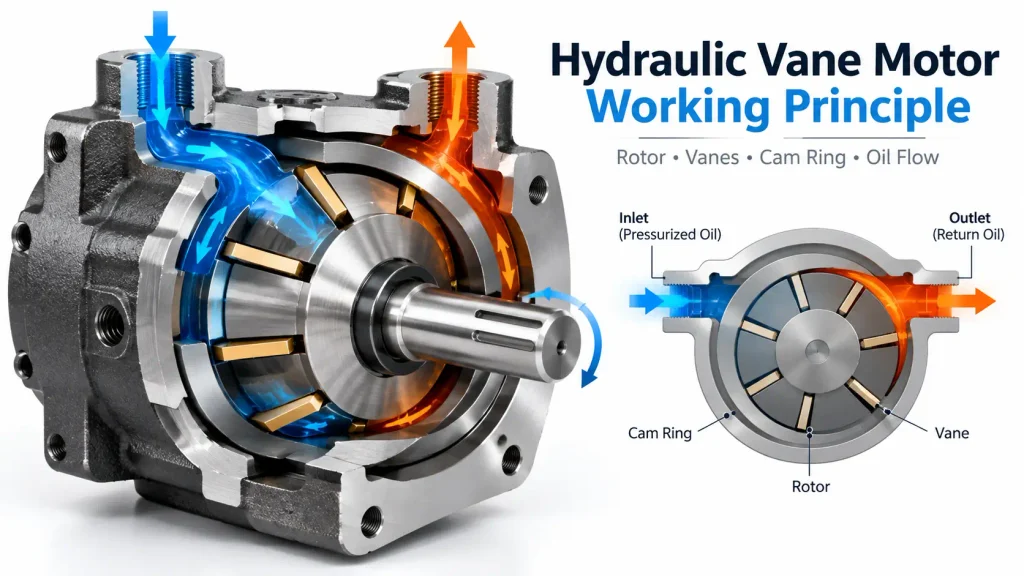
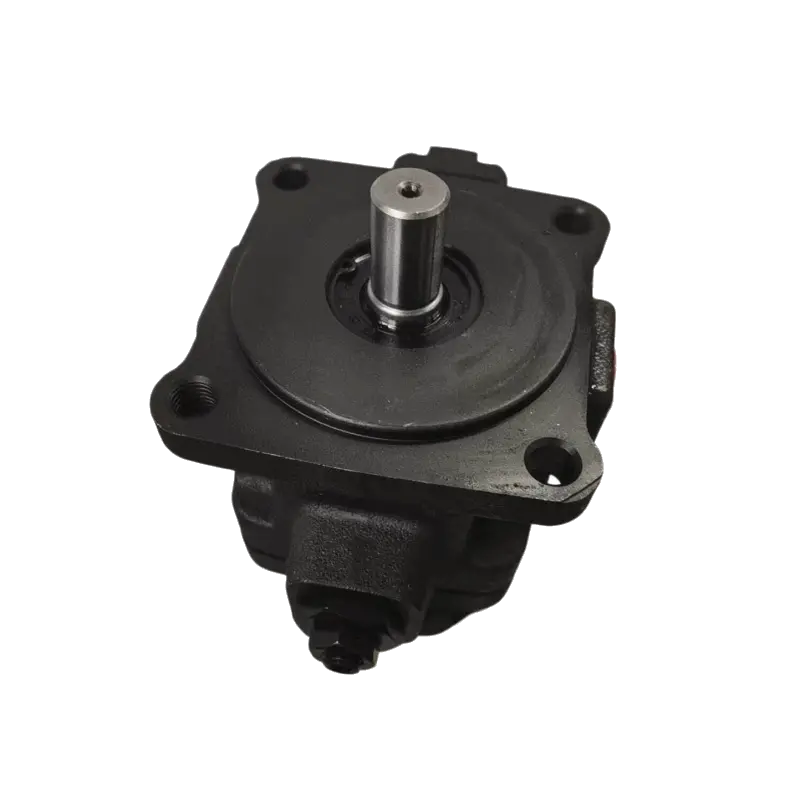
A vane pump is a rotary positive displacement pump in which vanes mounted in slots on a rotor turn inside a cavity, and the resulting chambers expand and contract to draw fluid in and push it out at a steady, nearly pulse-free rate.
The rotary vane pump traps a fixed volume of fluid per revolution instead of relying on velocity to build pressure. In the common eccentric design the rotor sits off-center, so the gap between rotor and housing changes as it turns, drawing fluid in as chambers expand and forcing it out as they contract.
Main Types of Vane Pumps
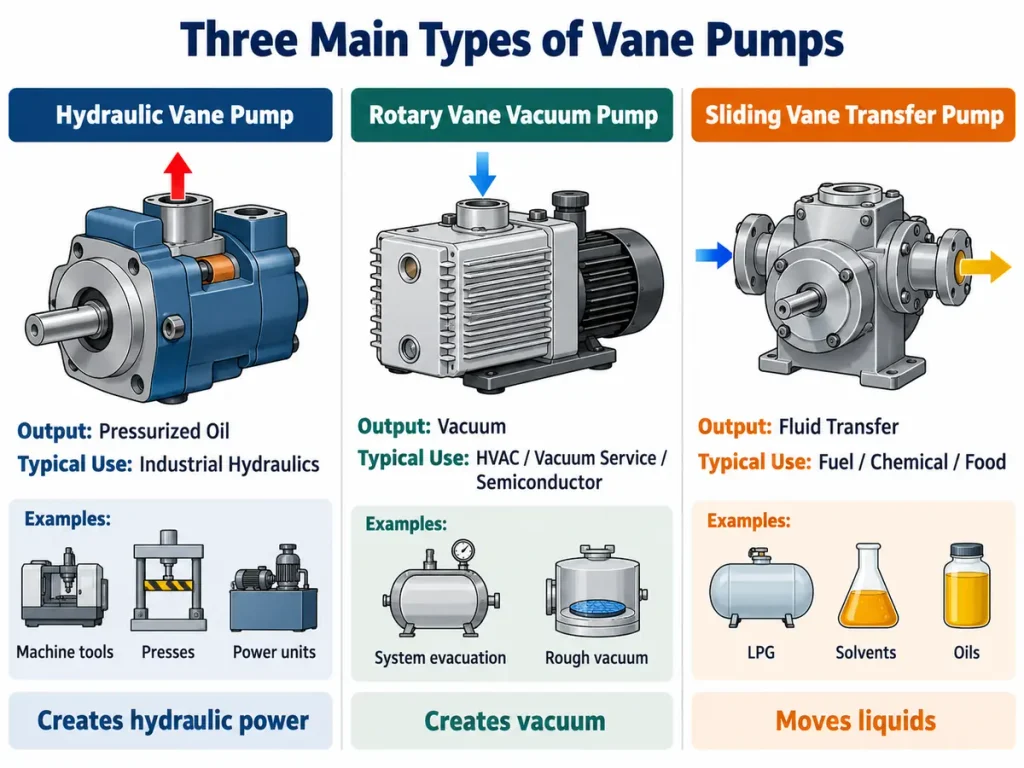
| Family | Function | Primary output |
| Hydraulic vane pump | Generates hydraulic power from a rotating shaft | Pressurized oil |
| Rotary vane vacuum pump | Removes air, vapor, and gas from a sealed volume | Vacuum |
| Sliding vane transfer pump | Moves liquid or gas between two points | Fluid flow |
A hydraulic vane pump is a power source, a rotary vane vacuum pump is a vacuum generator, and a sliding vane transfer pump moves product, and each is specified on different numbers. For a deeper breakdown of configurations, see What Is a Vane Pump.
How the Working Principle Shapes Performance
Positive displacement keeps output stable as system pressure varies, which suits metering and positioning duties, while variable displacement versions reduce stroke as demand falls to save energy.
Core Traits That Determine Application Fit
- Smooth, low-pulsation flow: often reduces the need for additional pulsation control
- Quiet operation: balanced designs cancel radial loads, which matters in cabs and hospitals
- Compact power density: high flow from a small envelope
- Consistent flow under varying pressure: suits dosing and metering
The trade-off is sensitivity: the tight clearances behind that efficiency are intolerant of contamination, poor lubrication, and sudden viscosity changes. Vane pumps perform best with low to medium viscosity fluids, clean media, stable temperatures, and moderate pressure.
Where Are Vane Pumps Used? An Industry Overview
Vane pumps are used in manufacturing hydraulics, automotive systems, aircraft circuits, refrigeration and HVAC service, chemical and fuel transfer, food and pharmaceutical processing, marine equipment, construction and mining, agriculture, and semiconductor fabrication.
Predictable displacement suits any process needing a repeatable volume of fluid or vacuum.
Vane Pump Applications at a Glance
| Industry | Typical application | Vane pump type |
| Manufacturing | Hydraulic power units, presses, machine tools | Hydraulic vane pump |
| Automotive | Power steering, transmission circuits, lubrication | Hydraulic vane pump |
| Automotive service | Fuel transfer, fluid evacuation | Sliding vane transfer pump |
| HVAC and refrigeration | System evacuation, dehydration, vacuum service | Rotary vane vacuum pump |
| Chemical processing | Solvent and acid transfer, distillation support | Sliding vane transfer pump |
| Food and beverage | Product transfer, dispensing, vacuum packaging | Sliding vane and vacuum pumps |
| Pharmaceutical | Freeze drying, vial filling, laboratory vacuum | Rotary vane vacuum pump |
| Semiconductor | Rough vacuum, backing duty, chamber evacuation | Dry rotary vane vacuum pump |
| Aviation and aerospace | Selected hydraulic circuits, ground support | Hydraulic vane pump |
| Construction and mining | Auxiliary circuits, steering, lubrication, leveling | Hydraulic vane pump |
| Marine and offshore | Deck machinery, steering gear, auxiliary control circuits | Hydraulic vane pump |
| Oil and gas | Fuel loading, LPG and ammonia transfer | Sliding vane transfer pump |
Industrial Hydraulics and Manufacturing Equipment
Industrial vane pumps supply hydraulic power to machine tools, injection molding machines, die casting equipment, presses, and metal forming lines, where steady flow and quiet running matter more than peak pressure.
This is where the vane design competes most directly with gear and piston pumps, and it usually wins on smoothness and noise rather than raw pressure. Industrial buyers can compare pressure, displacement, and mounting options across our Vane Pump Manufacturer range.

Machine Tools, Injection Molding, and Die Casting
Injection molding machines need a pump that holds clamp pressure for long periods while moving smoothly into the injection and holding phases. Consistent flow translates into repeatable part dimensions, and low noise keeps the pump practical where operators work alongside the equipment. Die casting follows the same logic at higher duty cycles, favoring durable cartridges and effective filtration.
Hydraulic Presses and Power Units
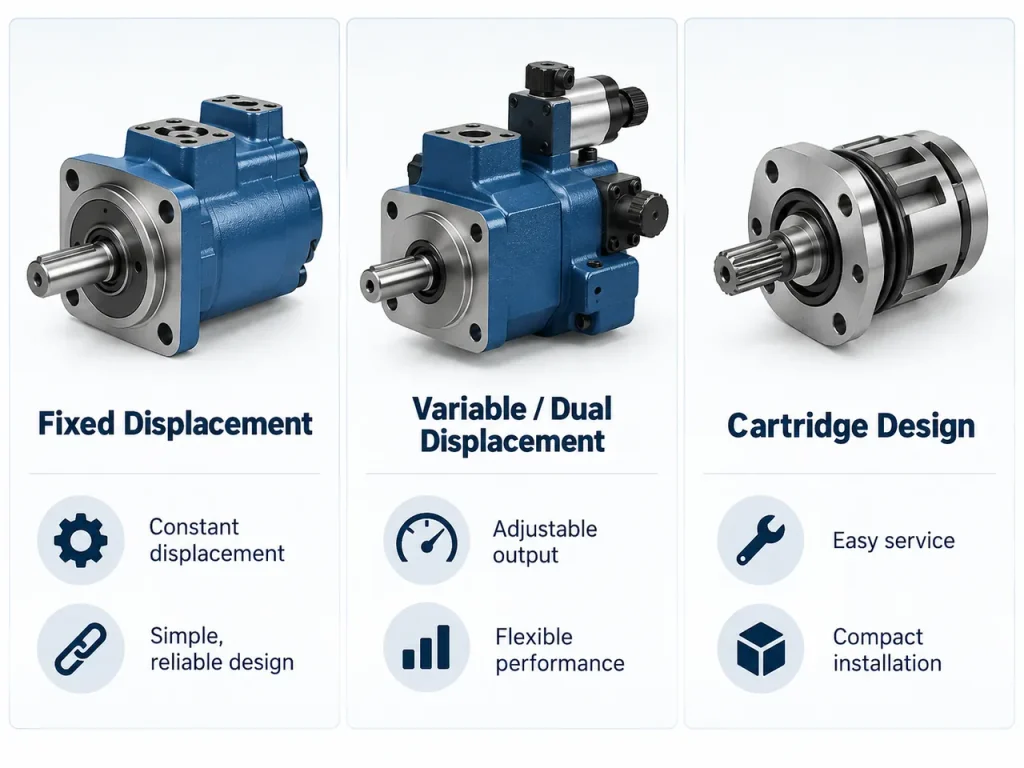
Presses need controlled force rather than extreme speed. A vane pump paired with proportional valves gives fine control over ram position and pressing force, and steady flow under load keeps part quality consistent across thousands of strokes. Where pressures climb beyond the vane range, piston pumps take over. Centralized power units follow the same logic: a Fixed Displacement Hydraulic Vane Pump suits continuous heavy duty, while a variable unit fits irregular load profiles.
Automotive and Transportation Applications
Vane pumps are used in vehicles for hydraulic power steering, transmission circuits, engine lubrication, brake vacuum assist, and fuel or fluid transfer during service work.
Packaging drives most of these choices. Engine bays offer little free volume, and steering and transmission circuits need a pump that is compact, quiet, and unaffected by pressure fluctuation.
Power Steering and Auxiliary Hydraulic Systems
Power steering is the textbook application. Fixed displacement pumps run at a fixed ratio to engine speed and dump surplus flow through a relief valve, which wastes energy. Variable displacement versions adjust internal eccentricity to match demand, and automakers have used them for this efficiency gain for decades. Auxiliary circuits such as cooling fan drives and active suspension follow the same pattern.
Transmission, Lubrication, and Fluid Transfer
Automatic transmissions use a vane pump to circulate fluid that both lubricates the internals and provides the pressure to engage clutches and bands, while continuously variable transmissions adjust pressure as the ratio changes. Not every automotive vane pump is hydraulic, though. Fuel dispensing and service equipment uses sliding vane transfer pumps for their strong suction and self-priming ability, so a transfer unit and a steering pump share little beyond the name.
Aerospace, Marine, Construction, and Agricultural Applications
Vane pumps can be used in selected aircraft hydraulic circuits and ground support systems; marine equipment uses them for steering gear and deck machinery; and construction and agricultural machinery uses them for auxiliary, steering, lubrication, and leveling duties.
These fields share a need for dependable, compact hardware that tolerates vibration and harsh environments.
Aircraft and Ground Support Systems
Vane pumps can be used in selected aircraft hydraulic and ground-support applications where compact size, smooth flow, and moderate pressure are appropriate. Commercial and military aircraft often run redundant hydraulic circuits powered by separate pumps, so flight controls keep working if one circuit fails. Maintenance facilities also rely on rotary vane vacuum pumps for altitude simulation testing, composite layup, and instrument servicing.
Marine and Offshore Hydraulics
Aboard vessels and platforms, hydraulic vane pumps drive steering gear, winches, cranes, and hatch covers, and offshore hydraulic power systems may also use vane pumps in selected auxiliary and control circuits. The pump must tolerate saline air, continuous vibration, and maintenance planned around port calls.
Construction, Mining, and Agricultural Machinery
Vane pumps are not the mainstream main pump on a large excavator, because digging pressure pushes beyond their comfortable range. Their role is auxiliary circuits, pilot pressure, fan drives, braking assist, and tool positioning. Tractors and combines use them for steering assist and implement circuits, where self-priming matters because machines sit idle between seasons. Operators replacing worn units can match pressure, displacement, and mounting across our Hydraulic Parts for Construction Industry range.

Refrigeration, HVAC, Vacuum, and Semiconductor Applications
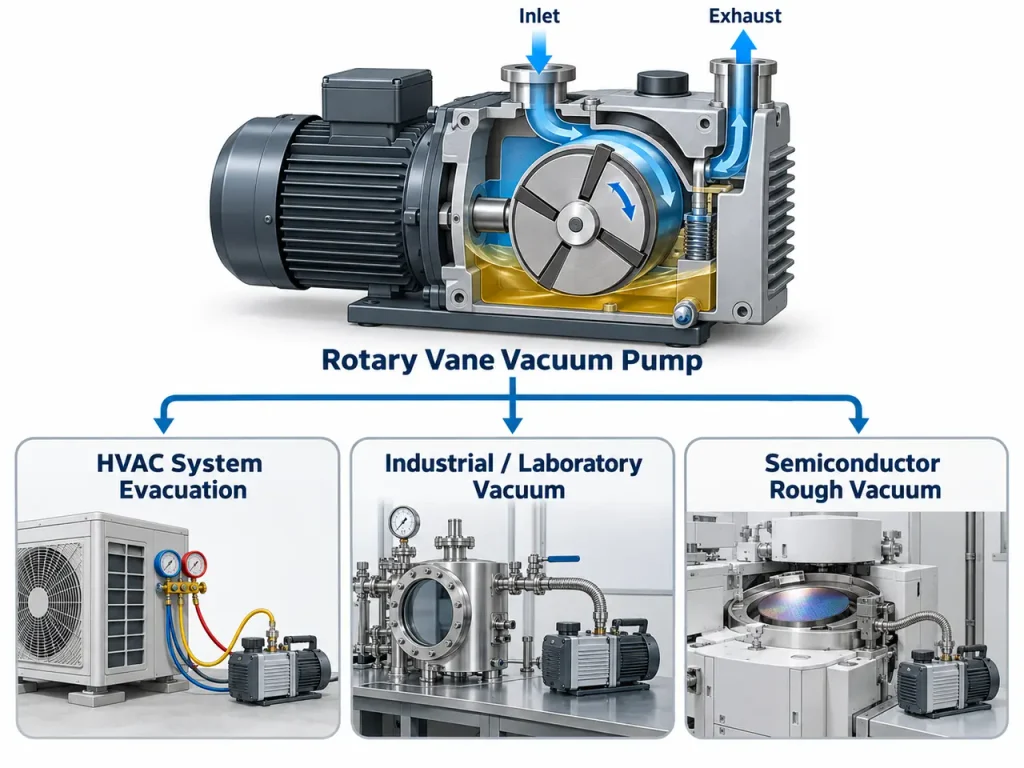
These applications generally use rotary vane vacuum pumps rather than hydraulic vane pumps, covering system evacuation before refrigerant charging, dehydration, vacuum service, freeze drying, laboratory vacuum work, and semiconductor process vacuum.
The mechanism is the same, but the job is different: the pump must remove gas from a sealed volume and hold a low absolute pressure, which shifts priorities to vacuum level, pumping speed, vapor handling, and oil quality.
HVAC System Evacuation and Vacuum Service
Before a refrigeration circuit is charged, it must be evacuated to remove air and moisture, which otherwise reacts with refrigerant to form acids that corrode the compressor. Technicians pull the system to a deep vacuum and hold it to confirm dryness and the absence of leaks.
Rotary Vane Vacuum Pump Applications
- Vacuum packaging of food, electronics, and medical supplies
- Freeze drying of food and pharmaceuticals
- Vacuum filtration, distillation, and degassing
- Tablet coating and vial filling
- Vacuum forming and resin degassing
- Paper handling and vacuum conveying
Semiconductor and Electronics Manufacturing
Cleanliness separates this segment from other vacuum work, because a single hydrocarbon molecule in the wrong place ruins a device at nanometer scale. Dry-running rotary vane pumps use no oil in the pumping chamber, removing any risk of backstreaming contamination. In practice the pump handles rough vacuum and chamber evacuation, bringing a chamber down to the point where a high-vacuum pump takes over. In semiconductor equipment, vane pumps may be used for selected roughing or backing duties, while the exact vacuum architecture depends on process chemistry and contamination requirements.
Food, Beverage, Chemical, Oil and Gas Applications
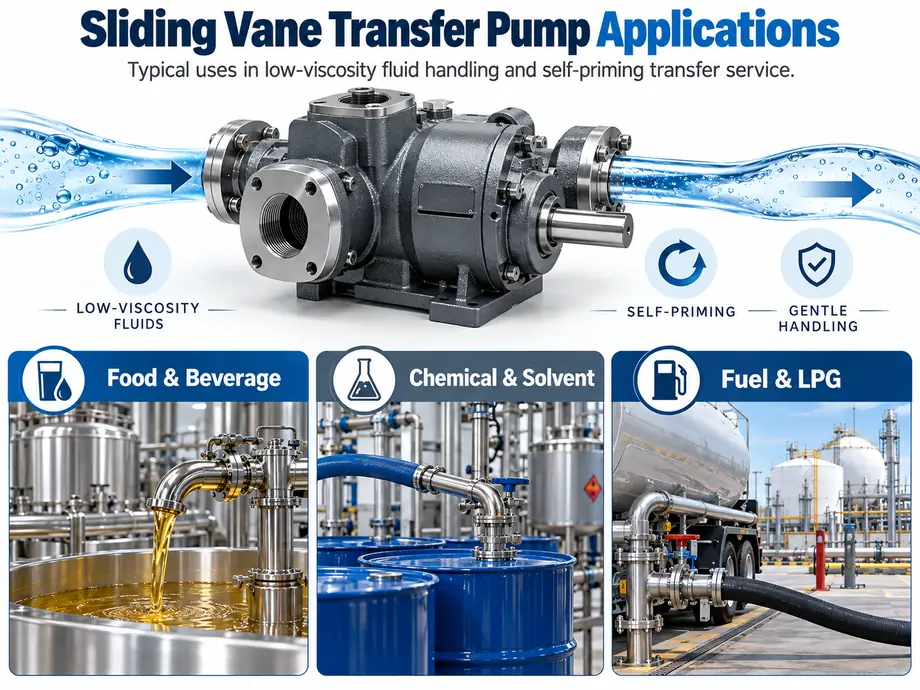
Food, beverage, and pharmaceutical duty uses sanitary sliding vane transfer pumps or rotary vane vacuum pumps, while chemical, fuel, LPG, and ammonia handling uses sliding vane transfer pumps for self-priming suction and low-viscosity tolerance.
In these duties the fluid is the product itself, so gentle handling, cleanability, and suction capability matter more than pressure rating.
Food and Pharmaceutical Fluid Handling
A pump in a dairy line must move viscous or shear-sensitive product without damaging it and must be cleanable, and vane designs meet both requirements because the vanes conform to the housing while producing low shear. Transfer duty covers oils, syrups, sauces, and beverage dispensing. Pharmaceutical production adds contamination control: vacuum pumps support tablet coating, vial filling, and freeze drying through long sublimation cycles.
Chemical and Solvent Transfer
Sliding vane transfer pumps handle solvents, light oils, and mildly corrosive chemicals because they self-prime, tolerate entrained vapor, and strip suction lines effectively; where the process also needs vacuum, a rotary vane vacuum pump takes over. Material choice is critical: stainless steel or coated internals for aggressive media, and elastomers matched to the chemical.
Fuel, LPG, and Ammonia Transfer
Bulk terminals and tanker unloading rely on self-priming vane pumps that can lift fuel from a below-grade tank without an external priming system. LPG and anhydrous ammonia must stay under pressure to remain liquid, so pumps built for this service handle the vapor formed during transfer.
Vane Pumps vs Other Pump Types
Vane pumps offer smoother flow and quieter operation than gear pumps, comparable efficiency at moderate pressure, and lower complexity than piston pumps, but they lose to gear pumps on contamination tolerance and to piston pumps on maximum pressure.
Comparison only makes sense inside a defined duty, so the comparisons below are split by whether the job is hydraulic power or liquid transfer.
Vane Pump vs Centrifugal Pump
This comparison belongs to liquid transfer rather than hydraulic power. A centrifugal pump converts impeller velocity into pressure, so its flow varies significantly with system pressure, while a vane pump is positive displacement and delivers nearly constant flow regardless of back pressure. For thin, clean fluids at high flow and low head, a centrifugal pump is efficient and inexpensive; viscous, self-priming, or metering duties favor the vane pump.
Vane Pump vs Gear Pump
A gear pump is simpler, cheaper, and more forgiving of contaminated fluid, making it the default for low-cost, high-viscosity, or dirty duties. A vane pump produces far less pulsation, runs quieter, and holds volumetric efficiency better as wear progresses, because the vanes keep sealing against the housing. In precision machinery where flow stability affects part quality, the vane design earns its higher cost.
Vane Pump vs Piston Pump
Piston pumps generally support higher pressures and more demanding hydraulic duties, while vane pumps are often preferred where low noise, smooth flow, and moderate pressure are priorities. Piston pumps are typically considered when required pressure or power density exceeds the practical range of the vane design.
Selecting and Maintaining Vane Pumps by Application
Selection starts with identifying which of the three families the application needs, then matching pressure or vacuum requirements, flow rate, fluid compatibility, and operating environment before any model is chosen.
Most specification failures trace back to a skipped first step: engineers select on pressure and flow, then discover the pump was built for hydraulic power when the process needed transfer duty. The Hydraulic Institute maintains pump standards and system guidance that are useful when defining the duty point for a new installation.
Selection Criteria
Answer three questions before opening a catalog: does the system need hydraulic power, vacuum generation, or fluid transfer? Then define the duty: continuous and peak pressure, displacement, and speed range for hydraulic service; target vacuum level, pumping speed, and vapor handling for vacuum service; flow at the required head and self-priming behavior for transfer service. Confirm viscosity at startup and operating temperature, because a cold start on thick fluid can starve a vane pump, and check seal compatibility against the actual fluid.
Maintenance and Failure Prevention
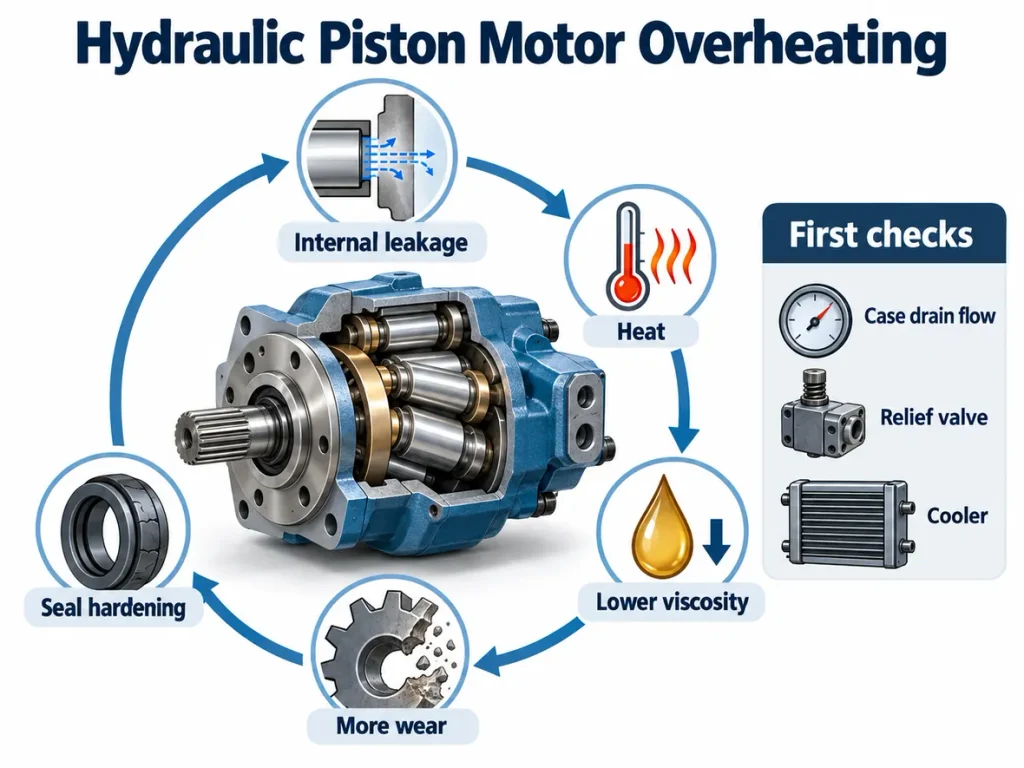
Vane pump maintenance is straightforward when fundamentals are respected: keep fluid clean, change filters on schedule, maintain oil quality in sealed vacuum pumps, monitor vane and cam ring wear, and watch for early warnings such as rising noise, falling flow, or unstable pressure. Most failures trace back to contamination, inadequate lubrication, or overheating rather than to the design itself. For replacement projects, matching displacement, mounting, and port configuration against our Hydraulic Pumps Manufacturer range avoids the rework of an incompatible swap.
Frequently Asked Questions
Where are vane pumps most commonly used?
Vane pumps are commonly used in automotive hydraulic systems, industrial power units, refrigeration and HVAC service, fluid transfer, marine equipment, and selected aerospace and semiconductor applications.
Are vane pumps used for hydraulic systems and vacuum systems?
Yes, but they are different products. A hydraulic vane pump generates pressurized flow to drive cylinders, motors, and valves inside a closed circuit, and is specified on pressure rating and displacement. A rotary vane vacuum pump removes gas from a sealed volume and is specified on achievable vacuum level and pumping speed. They share a rotor-and-vane geometry but use different materials, clearances, and sealing approaches.
What industries use hydraulic vane pumps?
Hydraulic vane pumps serve manufacturing, construction and mining, agriculture, aerospace, marine and offshore, and automotive. Within those industries they handle power units, machine tools, presses, steering assist, auxiliary circuits, and safety-critical control loops, concentrating wherever moderate pressure, steady flow, quiet operation, and compact size outweigh the need for maximum pressure capability.
When should I choose a vane pump instead of a gear or piston pump?
Choose a vane pump when flow stability, low noise, and compact power density matter more than maximum pressure or contamination tolerance. A gear pump is better value for low-cost, high-viscosity, or dirty duties where some pulsation is acceptable, while a piston pump is the more realistic option once required pressure or power density exceeds the practical range of a vane pump.