A machine that will not lift its rated load, a cylinder that creeps instead of holding, a press that stalls part way to its set pressure: faults like these arrive described as a pump problem, and the pump is often the first part removed. The pump sits at the center of the circuit while the oil usually escapes somewhere else, which is why pressure loss is so often misdiagnosed.
Hydraulic pump pressure loss comes from one of three conditions: the pump cannot draw enough oil, it passes oil internally through worn clearances, or the circuit opens a path that returns flow to tank before pressure can build. The pump is only one candidate among those three, and a gauge reading cannot separate them.
Diagnosing it means proving where the flow is going, not guessing which part has failed.
Why a Running Hydraulic Pump Can Have Low Pressure
A pump delivers flow, not pressure. Pressure appears only when that flow meets resistance from a load, a restriction or an orifice, so a running pump with a low reading may be working correctly and have nothing to push against.
A variable displacement pump destrokes as pressure approaches its compensator setting, and flow falls to whatever holds standby pressure. A directional valve in neutral, an unloading valve held open, or a function that is not commanded will all read low with no fault present.
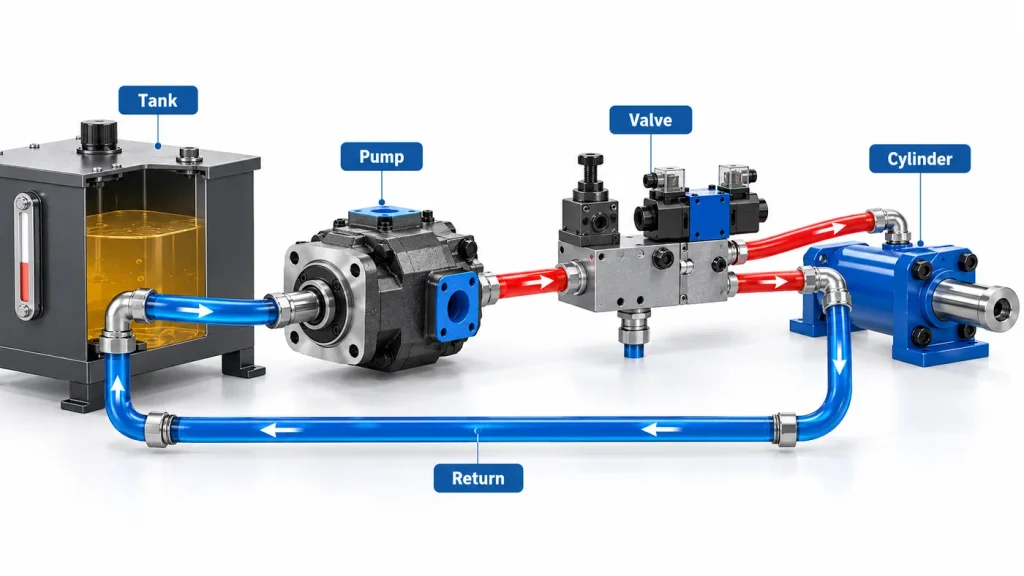
Once the machine is loaded, pressure follows the flow path: reservoir and suction line, pump, relief block, directional valve, actuator, return line. It is lost wherever that chain stops being sealed, in one of two forms.
- Under-supply. The inlet is restricted, the oil is too thick, the shaft speed is wrong, or the pump is worn, so too little oil enters.
- Abnormal bypass. Oil enters but reaches tank without doing work, through a relief valve, a leaking spool, a failed piston seal or a worn motor.
The two families are tested differently, which is why the order of the checks matters more than the length of the list.
The Most Common Causes of Hydraulic Pump Pressure Loss
Five fault groups account for most cases: internal leakage inside the pump, air entering the suction side and the cavitation it triggers, contaminated or wrong-viscosity oil, relief and control valves that bypass flow, and leakage at the actuator or through the drive.
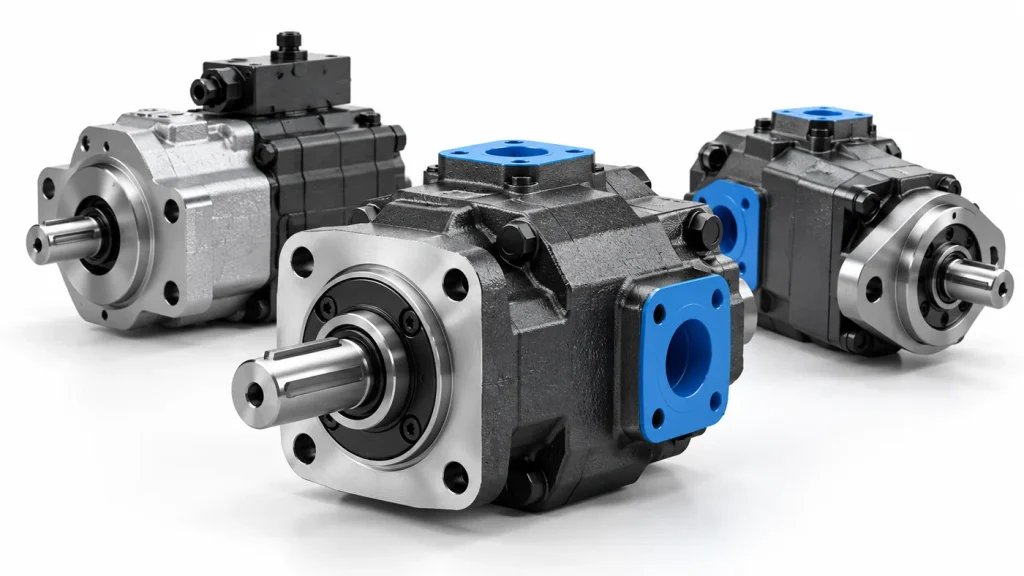
Wear does not progress the same way across types of hydraulic pumps: the symptoms a gear unit produces as its clearances open are not the ones a piston or vane unit produces.
Internal Leakage Inside the Pump
Every positive displacement pump separates high pressure from low pressure across a narrow clearance, and every clearance grows with use. In a piston unit the fit between each piston and its bore, and the condition of the valve plate, decide how much oil slips back to the case, which is why the permissible case drain flow quoted by a piston pump manufacturer differs so much between models; in gear pumps the end clearance at the gear faces plays the same role.
The evidence is a pattern in time rather than a single figure. Pressure is acceptable when the oil is cold and falls away at operating temperature, because thinner oil crosses the worn gap more easily. Case drain flow rises where it can be measured, and the housing runs hotter than the return line.
Suction-Side Air Ingress and Cavitation
Both make the pump noisy and cut output, but they are different faults with different repairs.
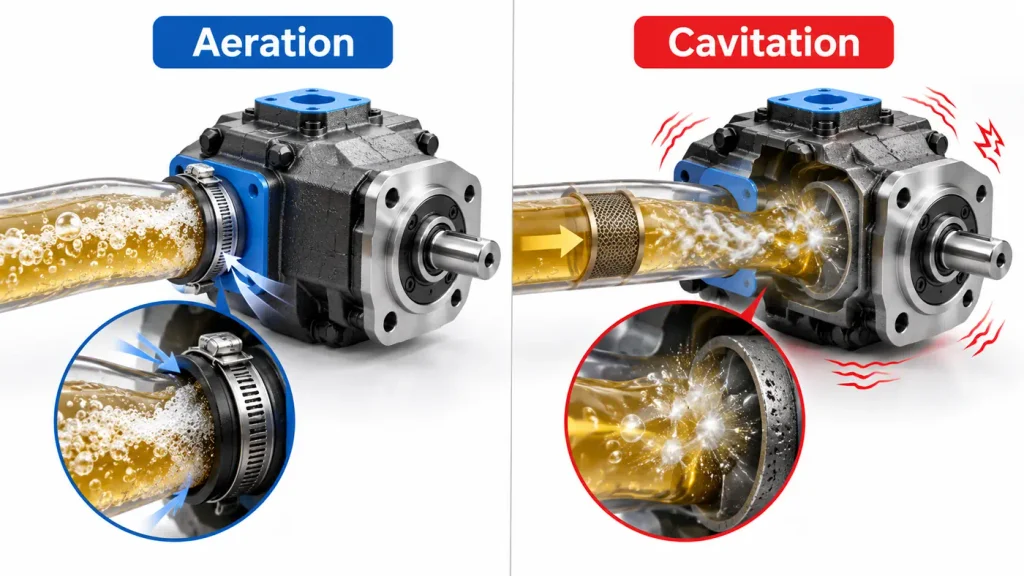
Aeration is outside air drawn in through a loose clamp, a cracked suction hose, a worn shaft seal or a return line discharging above the oil level. The oil becomes compressible, so actuators feel spongy and the system heats quickly.
Cavitation is a phase change inside the oil itself. When inlet pressure falls below the fluid’s vapor pressure, cavities form and collapse as they reach higher pressure, eroding metal surfaces. It is produced by excessive inlet resistance: a clogged strainer, a collapsing hose, oil too cold to flow, or speed above what the inlet can supply.
A suction leak can draw air without weeping oil, because the line runs below atmospheric pressure, so aeration is fixed at the entry point while cavitation is fixed by reducing inlet restriction.
Contamination and Incorrect Oil Viscosity
Particles small enough to pass a filter still abrade clearances, and water corrodes surfaces and breaks down the film that keeps those clearances from touching. Cleanliness is normally specified as an ISO 4406 code, and dark or cloudy oil has already exceeded it.
Viscosity produces the same symptom from both ends. Oil too thick cannot be drawn through the inlet, so the pump starves. Oil too thin crosses internal clearances too easily, so leakage rises and pressure falls as the system warms.
Relief Valve and Hydraulic Control Problems
A valve that stays partly open turns a pressure problem into a flow problem. The seat geometry and spool clearance that keep it closed are set at build by the hydraulic valve manufacturer, and contamination widens both until the valve no longer holds. A relief valve stuck open, set below the required pressure, or damaged at its seat passes flow straight to tank.
A sticking compensator keeps a pressure-compensated pump destroked, and a lost or leaking load-sense signal does the same to a load-sensing unit. A worn spool leaks from the pressure gallery to tank in every position.
Coverage is the useful split: one weak function points to that valve section, its actuator or its hoses, while weak performance everywhere points to the pump, main relief, suction supply and shared passages.
Actuator Leakage and Pump Drive Faults
A cylinder with a damaged piston seal bypasses oil from cap to rod end, so it drifts or stalls while the pump still delivers. A worn motor passes oil through its case drain. A slipping coupling, a sheared key, reversed rotation or low shaft speed reduces output in ways that look like pump wear.
Troubleshooting charts for hydraulic power units list causes in order of probability rather than severity, an ordering worth copying: the cheap checks are usually the common ones.
How to Diagnose Low Hydraulic Pressure Step by Step
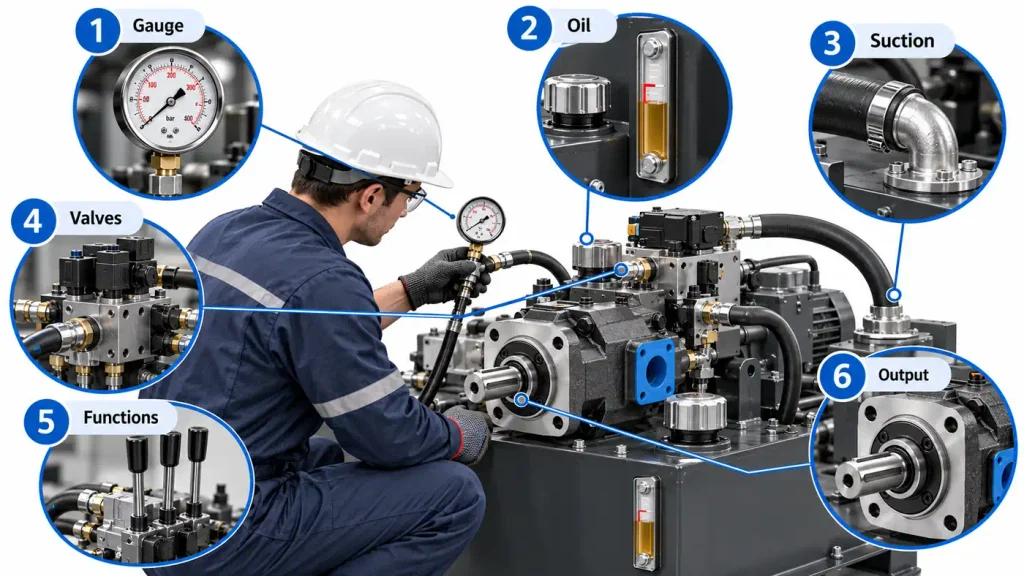
Work from the least invasive check to the most expensive: confirm the reading and the test conditions, verify supply and shaft speed, examine the valves that can bypass flow, isolate the fault to a single function, and only then measure the pump’s own output.
Hydraulic pump troubleshooting follows that order on every machine, and each step assumes the machine is stopped and depressurized unless the procedure requires it running. Lock out the drive, discharge any accumulator and secure a suspended load before opening a connection. Never loosen a leaking fitting under pressure, and never raise a relief setting to compensate for a low reading, because that setting protects hoses, seals and structures chosen for it. Where a test calls for blocking the outlet, follow the documented shutdown and depressurization procedure for that machine.
- Confirm the gauge and the test conditions. A damaged gauge or a blocked test port can make a healthy system look dead. Re-test at a known port if the reading cannot be trusted.
- Check oil level, temperature, viscosity, shaft speed and rotation. Correct a fault found here first, because it distorts every later measurement.
- Inspect the suction side. Strainer, hose condition, clamps, shut-off valve position and breather. Repair any restriction or air entry before continuing.
- Compare relief, unloading and compensator settings with specification. A valve that is passing or set wrongly is cleaned, calibrated or replaced, then re-tested.
- Test each function separately. One weak function points to its valve section, actuator or hose; performance that is weak everywhere points to the pump, main relief or shared supply.
- Measure pump output at rated speed, pressure and temperature. A flow test, or a case drain reading where the design permits it, separates a worn pump from a starved one.
How to Tell If a Hydraulic Pump Is Weak
A weak pump loses output on every function and gets worse as the oil reaches operating temperature. A system fault usually appears on one function, or only when a particular valve or actuator is loaded, while the pump’s own delivery stays within specification.
Pump Wear vs. Aeration vs. Cavitation
| Failure Type | Typical Symptoms | Key Diagnostic Evidence |
| Internal pump wear | Pressure falls as oil warms, output drops at rated speed, housing runs hot | Flow or case drain measurement below specification at rated conditions |
| Aeration | Foamy or milky oil, spongy actuator response, rapid heating | Air entry on the suction side or at the shaft seal, low reservoir level |
| Cavitation | Gravel-like rattle, vibration, pitting on internal surfaces | Excessive inlet restriction, inlet vacuum above the pump limit, oil too cold or too thick |
| Valve bypass | Pump delivers flow, system never reaches its set pressure | Relief or unloading path open, valve passing, pressure capped at a fixed ceiling |
Sound and oil appearance alone cannot separate a hydraulic pump losing pressure from a circuit losing it, and aeration can occur alongside cavitation. The mechanism decides: one is air from outside, the other is vapor formed when local pressure drops below the fluid’s vapor pressure. The repairs differ, as a technical comparison of aeration and cavitation sets out.
Pump Failure vs. System Pressure Loss
A hold test does not clear a seal. Capping both cylinder ports can stop a load from drifting even with a failed piston seal, because the trapped pressure equalizes and then acts on unequal piston areas. Judge the seal by measured leakage, not by whether the load stays up.
A system that reaches full pressure at no load and loses it under load is bypassing flow somewhere. A system that never reaches its setting at deadhead has a supply or control problem.
How to Fix Low Hydraulic Pressure
Fix the cause rather than the reading: restore clean oil at the specified viscosity, seal the suction line, clean or replace the valve that is passing flow, and renew the seal that is leaking. Rebuild or replace the pump only when measured output falls below specification at correct speed and temperature.
Correct Fluid, Suction and Valve Problems
- Low, aerated or wrong-grade oil. Fill to the specified level with the correct grade, and confirm that return lines discharge below the oil surface.
- Restricted inlet. Clean or replace the strainer, replace a soft or collapsing hose, and check that the shut-off valve is fully open.
- Contaminated oil. Replace oil and filter elements, clean the reservoir, and re-check cleanliness against the specified code.
- Valve passing flow. Clean, reseat or replace the relief, unloading or directional valve, then set it with a calibrated gauge.
- Actuator leakage. Renew the piston or rod seals, or replace the motor, and confirm by leakage measurement.
When to Rebuild or Replace the Pump
Rebuilding suits a pump whose housing, shaft and bearings are serviceable and whose loss comes from seals, valve plates or rotor sets. Replacement is the better route when the housing is damaged, when repair cost approaches the price of a new unit, or when downtime outweighs the difference. approaches the price of a new unit, or when downtime outweighs the difference.
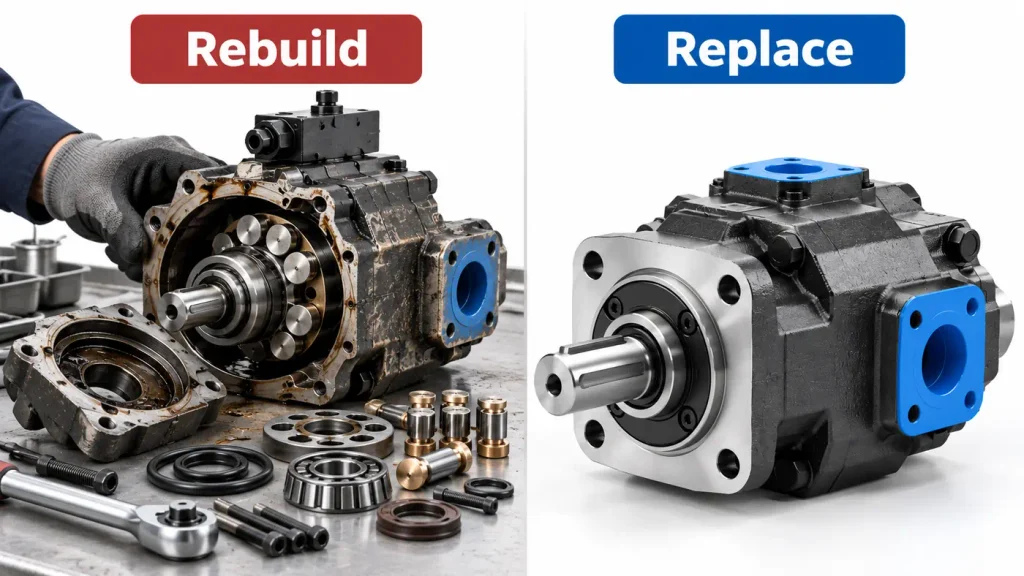
Either way the unit must match the original on pressure rating, displacement, rotation, shaft and mounting flange, port positions and control type. Quote the data plate rather than the machine name, because that code is what any hydraulic pumps manufacturer matches a replacement against, and a unit correct in displacement but wrong in compensator setting reproduces the original complaint. Prime the new unit and seal the suction line before the first start, or the first hour of running will undo the repair.
How to Prevent Hydraulic Pressure Loss
Prevention means holding three conditions stable: supply, containment and control. Clean oil at the right viscosity, a suction line that stays sealed, and valves that keep their settings close most of the routes by which pressure escapes.
Supply fails when filters run past their service interval, when oil is topped up with the wrong grade, or when a suction hose softens with age. Containment fails at seals and at every joint that has been opened and re-tightened. Control fails quietly, because a relief valve adjusted by hand rarely returns to its specified setting on its own.
A short baseline record makes all three visible: pressure at standby and at rated load, oil temperature at operating condition, and case drain flow where it can be measured, logged at the same interval each time. A pump that is starting to wear shows a trend months before an operator notices a slow cycle.
Frequently Asked Questions
Most pressure faults that come back after a repair trace to three things: oil of the wrong grade, air left in the circuit, and a machine kept running on a low reading until a seal or a wear surface fails.
Why Did My Hydraulic Pump Lose Pressure After an Oil Change?
Most often the new oil is the wrong viscosity, the pump lost its prime during the change, or air entered through a line that was opened. Oil thicker than specified starves the inlet at low temperature, and oil thinner than specified increases internal leakage once it warms, so pressure looks worse than before the service. Check the grade against the machine specification, confirm the suction line was re-primed, and verify that every joint opened during the work is sealed.
Can Air in a Hydraulic System Permanently Damage the Pump?
Yes, if it continues long enough. Free air removes the oil film that separates moving surfaces and raises local temperature as it is compressed, while cavitation erodes metal directly. Short episodes usually leave no lasting damage once the source is sealed. Repeated episodes show up as falling volumetric efficiency, pitting on internal surfaces and metal particles in the filter, at which point only a rebuild or replacement restores output.
Is It Safe to Keep Running a Machine With Low Hydraulic Pressure?
No, not beyond the time needed to move it to a safe position. Low pressure usually means oil is being forced through a gap that was never designed for it, and the energy ends up as heat. Seals harden, oil degrades faster, and a small internal leak grows into a damaged wear surface. A machine that cannot hold pressure may also fail to hold a suspended load, so stop it, secure the load and diagnose before returning it to production.