Choosing a hydraulic pump by horsepower or physical size alone often leads to poor performance. A pump that is too small cannot meet the required speed and force, while an oversized pump wastes energy and generates unnecessary heat. Buyers who compare hydraulic pumps usually find that the deciding factor is not the pump itself but the duty the machine has to perform.
The correct hydraulic pump size is determined by the required flow rate, operating pressure, motor speed, and pump efficiency. Calculate the required displacement first, then select a pump type that matches the duty cycle and pressure range.
This guide explains how to calculate hydraulic pump size step by step and what specifications to confirm before ordering.
Start With the Duty Point, Not the Pump
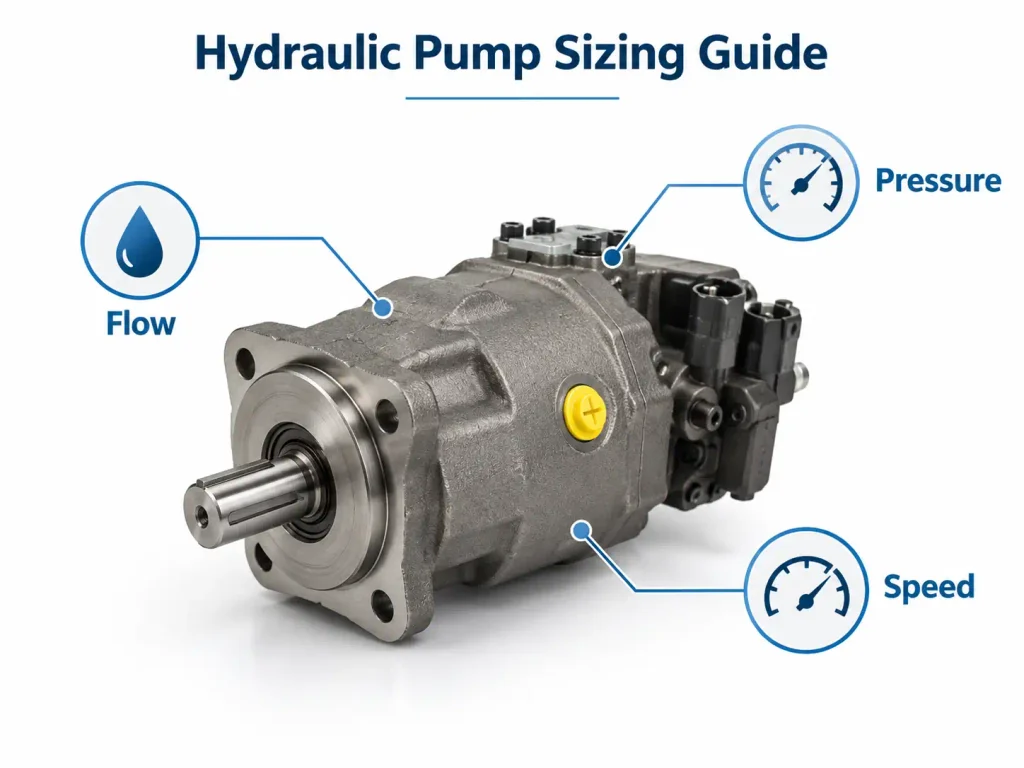
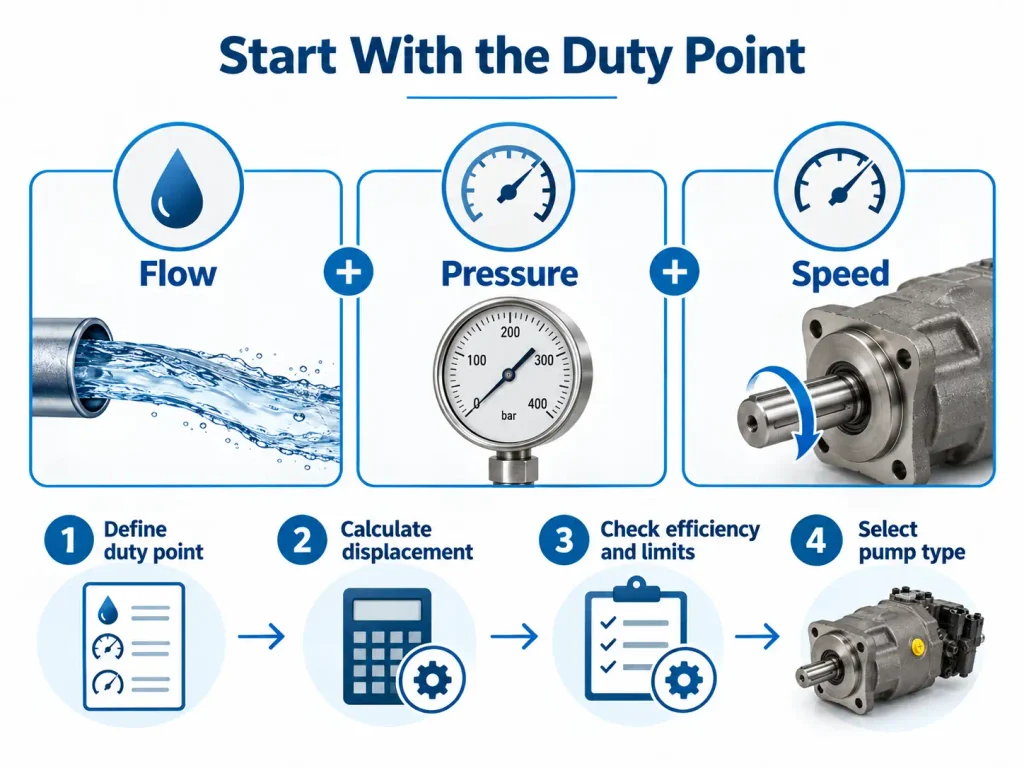
The duty point is the single operating condition your pump must satisfy: the delivered flow the actuator needs, the pressure difference the load creates, and the shaft speed the prime mover supplies. Every sizing number comes from that point, never from a model number.
Most sizing mistakes come from a reversed order of work: the model is chosen first and the circuit demand is checked last. The reliable sequence runs the other way:
- Define the duty point: delivered flow, working pressure difference, and shaft speed at the same moment.
- Calculate the required displacement from flow and speed.
- Correct for efficiency and check the operating limits.
- Select the pump type and confirm the installation details.
Flow Sets Actuator Speed
Flow is the volume of oil delivered per unit of time, and it decides how fast an actuator moves. A cylinder extends at a speed proportional to flow divided by piston area, and a motor turns at a speed proportional to flow divided by displacement. Slow movement at light load points to flow, not pressure.
Pressure Sets Force and Load Capacity
Pressure is a consequence of resistance, not something the pump chooses; the load, the relief valve setting and the flow restriction create it. Cylinder force equals working pressure multiplied by piston area, so the figure that matters is the pressure difference between outlet and inlet at the duty point, the mechanism by which hydraulic machinery converts flow and pressure into work. Underestimating it stalls the pump under load; overestimating it wastes cost and heat.
Shaft Speed Determines Required Pump Displacement
A pump does not choose its own output on each revolution. Displacement is a fixed volume per revolution, and flow is displacement multiplied by shaft speed, so once both are known the required displacement follows directly. Understanding How Do Hydraulic Pumps Work makes this arithmetic easier to trust.
Continuous, Intermittent and Peak Duty
Record the duty point as a set of stages, not one number. Continuous duty is the condition the machine holds for most of its life, intermittent duty is the short higher-load condition it reaches regularly, and peak duty is the brief maximum that occurs rarely. Continuous, rated, intermittent and peak pressure are defined differently by each maker, so a peak figure is never a continuous setting.
| Equipment Type | Typical Flow Range | Typical Pressure Range | Duty Pattern |
| Small hydraulic power unit | 5 to 20 L/min | 100 to 200 bar | Intermittent |
| Injection moulding machine | 30 to 200 L/min | 150 to 300 bar | Continuous |
| Excavator hydraulic system | 100 to 400 L/min | 250 to 350 bar | Heavy duty |
| Machine tool power pack | 10 to 60 L/min | 70 to 160 bar | Continuous |
| Press or log splitter | 20 to 60 L/min | 150 to 250 bar | Intermittent with peak |
Treat these ranges as orientation only, since the real duty point comes from the machine. Never multiply the maximum flow of one stage by the maximum pressure of another unless both occur together, and for sequential functions size the pump for the largest single stage, not the sum.
How to Calculate Hydraulic Pump Capacity
Hydraulic pump capacity is the combination of displacement, pressure rating, and drive power needed to deliver the required flow at the duty pressure. Find it in four steps: calculate the required flow, convert that flow into displacement, correct the displacement for volumetric efficiency, and then size the drive power.
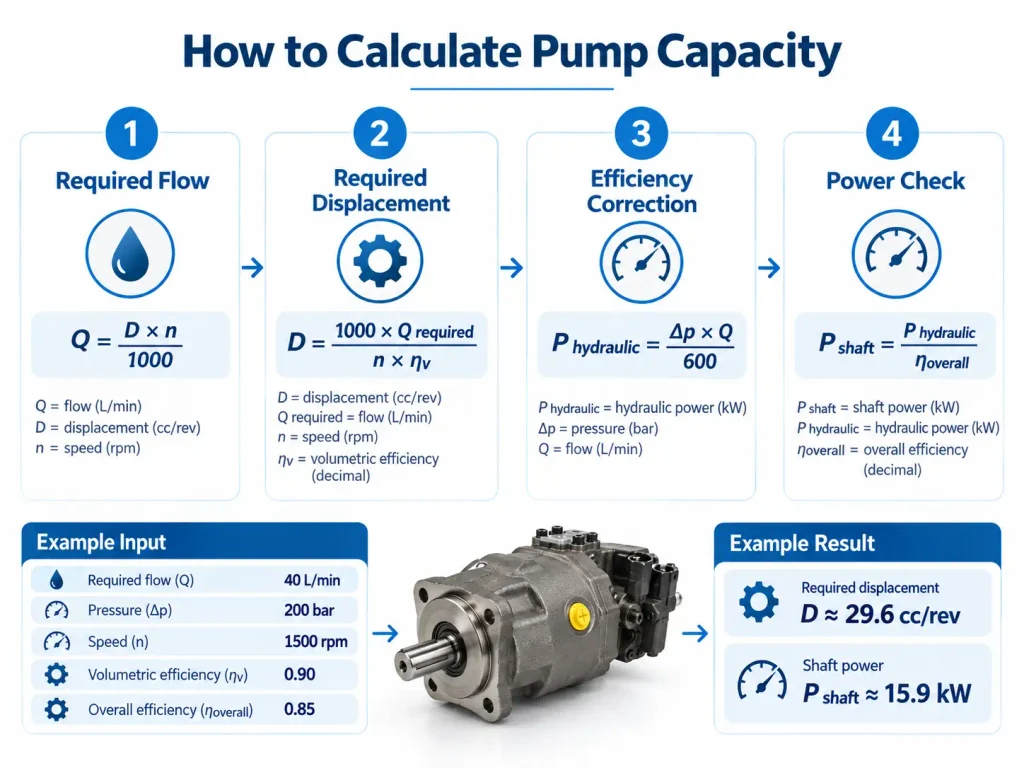
The formulas below use litres per minute, bar, cubic centimetres per revolution and kilowatts. For imperial work, use gallons per minute, pounds per square inch and cubic inches per revolution, and confirm whether a quoted gallon is US or imperial.
| Quantity | Formula | Units |
| Theoretical flow | Q = D x n / 1000 | L/min, with D in cc/rev and n in rpm |
| Delivered flow | Q delivered = D x n x volumetric efficiency / 1000 | L/min |
| Required displacement | D = 1000 x Q required / (n x volumetric efficiency) | cc/rev |
| Required displacement, imperial | D = GPM x 231 / RPM | cubic inches per revolution |
| Hydraulic power | P hydraulic = pressure difference x delivered flow / 600 | kW, with bar and L/min |
| Shaft input power | P shaft = P hydraulic / overall pump efficiency | kW |
| Input horsepower, imperial | HP = PSI x GPM / (1714 x efficiency) | hp |
Calculate Required Flow
Start from actuator demand, not from a catalogue. For a cylinder:
Q = A x v / 1000
where A is the effective piston area in square centimetres and v is stroke speed in centimetres per minute, giving litres per minute. The imperial equivalent is GPM = A x S x 60 / (T x 231), with area and stroke in inches and T the extension time in seconds. Add the flow consumed by any bypass, priority or cooling branch, then check the total against valve capacity and line velocity.
Calculate Required Pump Displacement
Because flow is displacement multiplied by speed, the required displacement can be read once flow and speed are known. Note that the nominal number in a model code is not always the exact geometric displacement, so record each candidate’s published actual displacement beside its model reference.
Adjust Displacement for Pump Efficiency
This is the step most sizing discussions skip. Internal leakage means delivered flow is always below theoretical flow:
Q delivered = D x n x volumetric efficiency / 1000
Volumetric efficiency on a healthy, correctly warmed pump usually sits between 0.90 and 0.95, and it falls as the pump wears, the oil heats and pressure rises. Rearranged, the practical requirement becomes:
D = 1000 x Q required / (n x volumetric efficiency)
Where drive speed varies, repeat the calculation for each pressure band, because minimum allowable pump speed itself changes with pressure.
Calculate Hydraulic Power Requirement
Hydraulic power rises with both pressure and flow:
P hydraulic = pressure difference x delivered flow / 600
with pressure in bar and flow in litres per minute giving kilowatts. Shaft input is higher, because the pump consumes part of what it receives:
P shaft = P hydraulic / overall pump efficiency
In imperial units the same idea appears as HP = PSI x GPM divided by 1714 times efficiency. Size the prime mover on the shaft figure after allowing for coupling losses, and keep the relief valve setting inside the continuous pressure rating rather than the peak rating. Pump performance and efficiency conventions are standardised by bodies such as the Hydraulic Institute.
A Worked Sizing Example
Assume a circuit that must deliver 40 litres per minute at 200 bar working pressure, driven at 1500 rpm, with volumetric efficiency 0.90 and overall pump efficiency 0.85.
| Step | Calculation | Result |
| Required delivered flow | given by the circuit demand | 40 L/min |
| Required displacement | 1000 x 40 / (1500 x 0.90) | 29.6 cc/rev |
| Candidate displacement | nearest standard size above the requirement | 30 cc/rev |
| Delivered flow of candidate | 30 x 1500 x 0.90 / 1000 | 40.5 L/min |
| Hydraulic power | 200 x 40.5 / 600 | 13.5 kW |
| Shaft input power | 13.5 / 0.85 | 15.9 kW |
| Drive selection | 15.9 kW plus a documented margin | above 15.9 kW |
The 29.6 cc/rev result is a requirement, not an order code. The candidate must be checked against its published actual displacement, then the resulting 40.5 litres per minute rechecked against actuator speed, valve capacity and line velocity.
Choose the Right Hydraulic Pump Type After Sizing
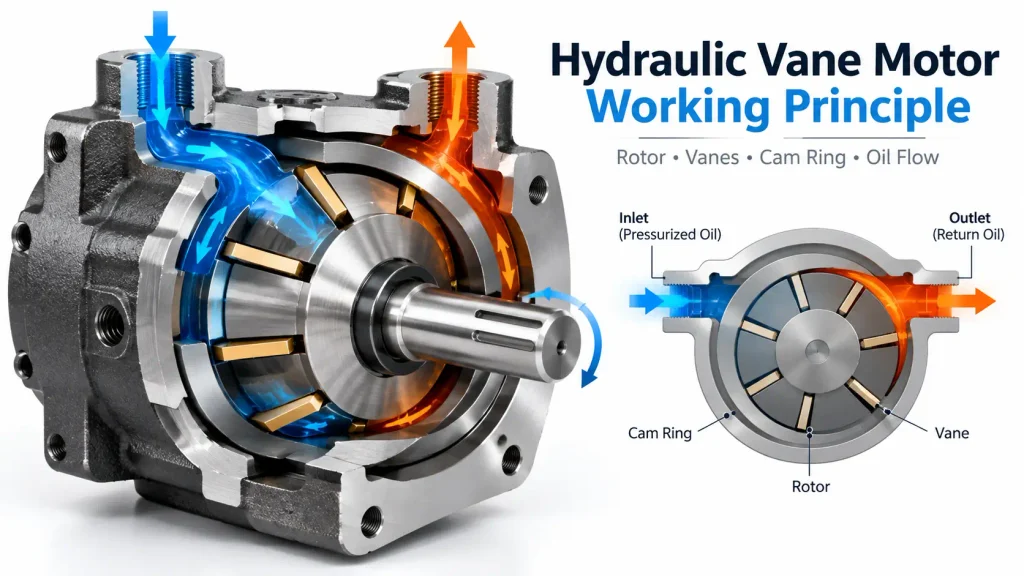
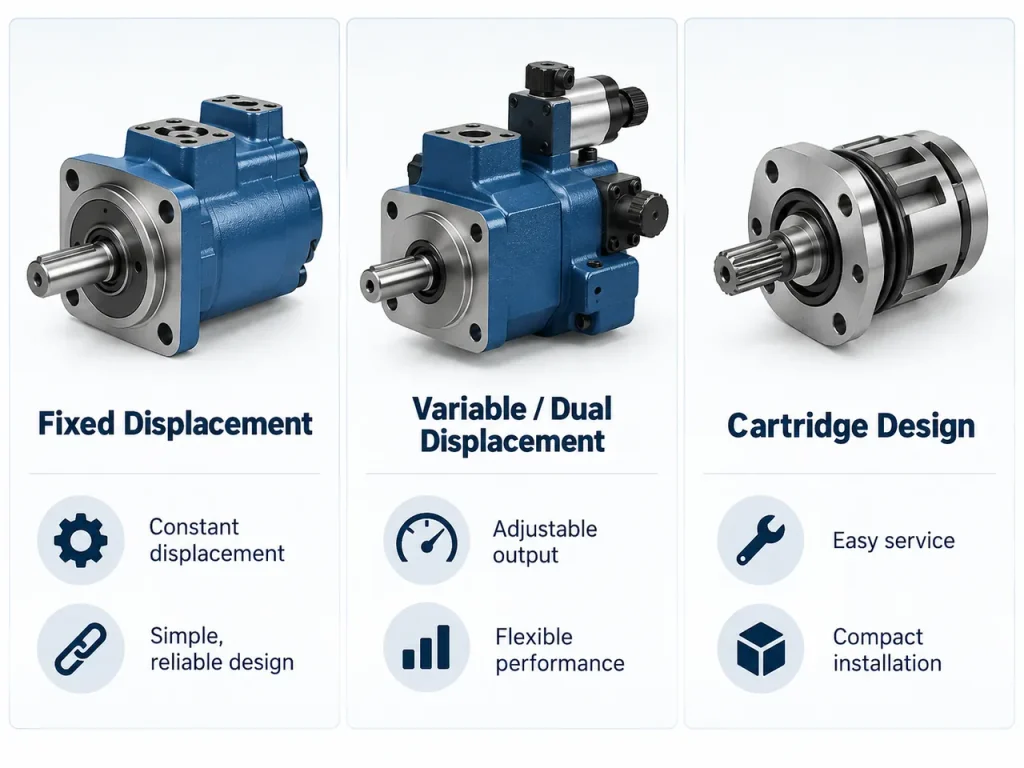
Sizing produces two numbers, a required displacement and a required pressure class, and the pump type is chosen by matching those numbers to the pressure range, efficiency and duty pattern of each design. External gear pumps suit simple, cost-sensitive circuits, vane pumps suit steady and quieter industrial duty, and axial piston pumps suit high pressure and variable flow.
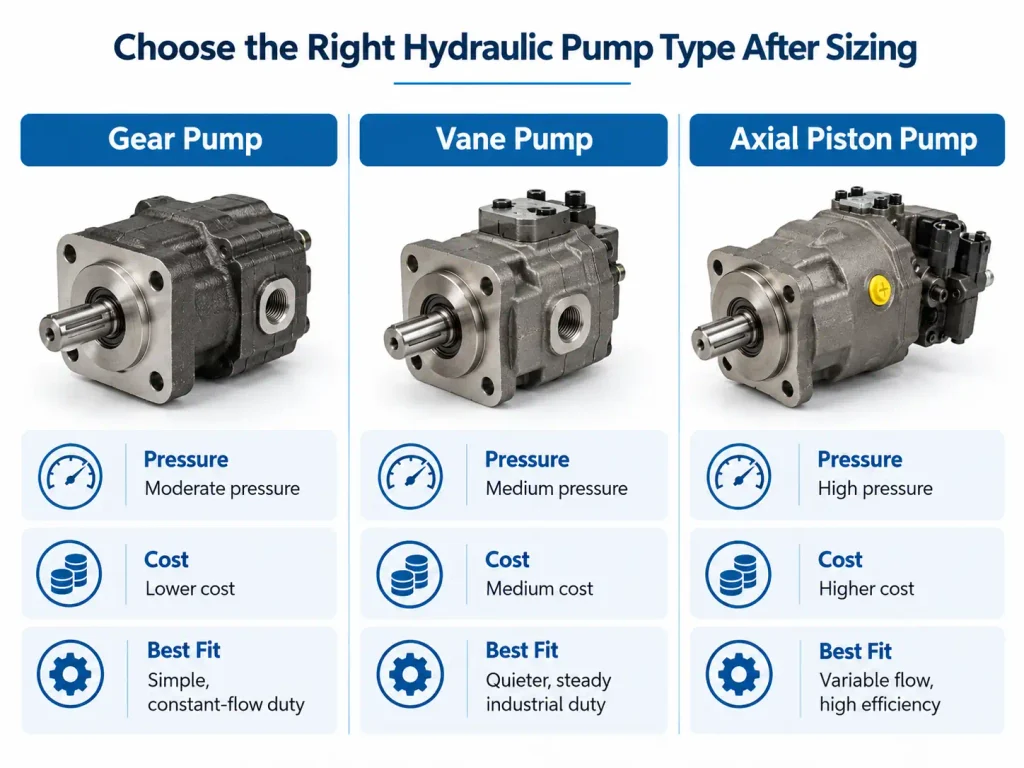
Across displacement pump designs, the three families sit on a consistent ladder of pressure capability, efficiency and cost, and the type follows from the numbers rather than preceding them.
Gear Pumps for Simple, Cost-Sensitive Duty
Gear pumps are fixed displacement units with few moving parts that tolerate contamination well and stay economical to replace. Their continuous pressure capability is the most modest of the three families, so they suit constant flow, moderate pressure, and duties where cost of ownership matters more than fine control. A Gear Pump Manufacturer normally offers a wide displacement spread for mobile equipment and small power units.
Vane Pumps for Steady, Quiet Industrial Duty
Vane pumps run noticeably quieter and hold efficiency well when flow and pressure stay steady, and variable versions reduce heat generation when much of the cycle sits at low demand. Their weakness is sensitivity to contamination, so filtration quality affects service life directly. A Vane Pump Manufacturer supplies them for machine tools and industrial power packs where noise and stability count.
Piston Pumps for High Pressure and Variable Flow
Axial piston pumps reach the highest continuous pressures, deliver the best overall efficiency, and are the only family offering practical variable displacement across a wide range. That capability carries the highest unit cost and the strictest clean-fluid requirement. Where the duty point sits above what gear and vane designs handle comfortably, a Piston Pump Manufacturer is effectively the only available answer.
Comparing the Three Families
| Pump Family | Typical Continuous Pressure | Typical Efficiency | Relative Cost | Best Fit |
| External gear | up to about 250 bar | Moderate | Low | Mobile equipment, small power units, constant flow |
| Vane | up to about 280 bar | Moderate to high | Medium | Machine tools, quieter industrial circuits |
| Axial piston | 350 bar and above | High | High | Heavy duty, high pressure, variable flow |
Oversized vs Undersized Hydraulic Pumps: Common Problems
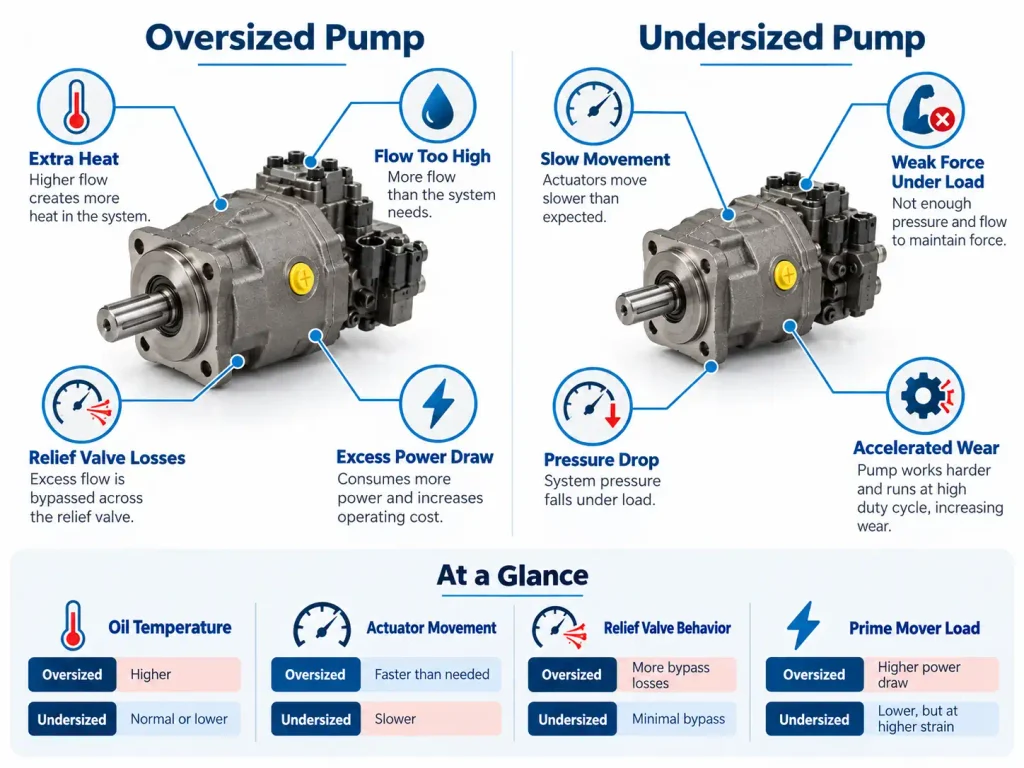
An oversized pump delivers more flow than the circuit can use, so the excess energy turns into heat, noise and throttling losses, while an undersized pump runs at or near its limit and cannot hold the required speed or force. Both shorten component life, but they fail in visibly different ways.
Symptoms of an Oversized Pump
- Oil temperature climbs during ordinary operation because surplus flow is converted into heat.
- Actuators move faster than the process can control, producing jerky movement.
- The relief valve passes flow continuously rather than only at the end of a stroke.
- The prime mover draws more power than the duty requires.
Symptoms of an Undersized Pump
- Movement is sluggish even at light load, and the machine hesitates under load.
- The prime mover runs near or above its rated load and overheats.
- Pressure droops under normal working load, so a cylinder slows or stalls.
- The pump runs at maximum capacity continuously, accelerating internal wear.
Oversized vs Undersized at a Glance
| Observation | Oversized Pump | Undersized Pump |
| Oil temperature | Runs hot under normal load | Rises only when working hard |
| Actuator movement | Too fast to control precisely | Slow, and hesitates under load |
| Relief valve | Frequently passing flow | Rarely opens |
| Prime mover | Draws more power than the duty requires | Runs near or above rated load |
| Component wear | Seals and bearings wear early | Pump and motor overheat |
Sizing Checklist Before You Order
Before ordering, confirm that displacement, maximum pressure, operating speed range, mounting, shaft and ports all match the duty point, and that the fluid viscosity and cleanliness class stay inside the pump rating. A pump that satisfies the flow and pressure numbers but fails an installation or fluid check is still the wrong pump.
| Specification | Why It Matters |
| Displacement | Determines flow output at the drive speed |
| Maximum pressure | Prevents overload, since continuous, intermittent and peak ratings are defined differently between makers |
| Operating speed | Affects the flow calculation, and sets the minimum and maximum speed limits |
| Mounting type | Ensures the pump fits the bracket, adapter or bell housing |
| Shaft type | Mechanical compatibility with the coupling, pulley or power take-off |
| Port size and type | Prevents restriction and ensures reliable sealing |
| Rotation direction | Must match the drive direction as viewed from the shaft end |
Fluid is a sizing input rather than an afterthought. Most industrial systems run on anti-wear mineral oil in an ISO VG 46 grade, with VG 32 for cold or precision duty and VG 68 for high temperature or high load. Thin hot oil increases internal slip and reduces delivered flow, while thick cold oil can starve the inlet at start-up, so inlet viscosity must stay inside the range the maker specifies. Cleanliness, expressed as an ISO 4406 code, influences pump life as much as any dimension, and piston pumps generally need a cleaner class than gear pumps.
Apply a documented margin rather than a vague one. Adding 10 to 20 percent to the calculated displacement allows for pipe ageing, filter loading and measurement uncertainty, but stacked and undocumented margins are what actually produce an oversized pump.
FAQ
Why does a pump deliver less flow than the calculated figure?
Because the calculated figure is normally theoretical flow, and the gap between theoretical and delivered flow is internal leakage. Oil slips back across internal clearances, and slip grows with pressure, temperature and wear. Catalogue figures are also often theoretical values taken at one reference speed and viscosity, so measure flow downstream while recording oil temperature and shaft speed.
Does hydraulic fluid viscosity affect which pump size I choose?
Yes, in two directions. Oil that is too thin once hot increases internal leakage, so the pump must be larger or more efficient to hold the required delivered flow when warm. Oil that is too thick when cold raises inlet resistance and can cause cavitation at start-up, which constrains suction line and reservoir layout rather than displacement.
What information should I provide when requesting a pump quotation?
Provide the application and its hydraulic functions, the delivered flow at each duty point, the shaft speed including minimum and maximum, outlet pressure with the inlet condition and resulting pressure difference, the duration and frequency of normal, intermittent and peak stages, and the fluid type, viscosity and temperature range. For a replacement, add the original code, nameplate and drawings, plus shaft, flange, port, rotation and drive data.
Can I replace a hydraulic pump with a higher displacement model?
Not as a simple upgrade, because a larger displacement raises flow at the same drive speed and that extra flow has to go somewhere. Check the prime mover rating, then confirm that valves, lines and cooler handle the higher flow rate. The relief setting and continuous pressure rating must still match the circuit, and actuator speed limits may already be reached at the lower flow.