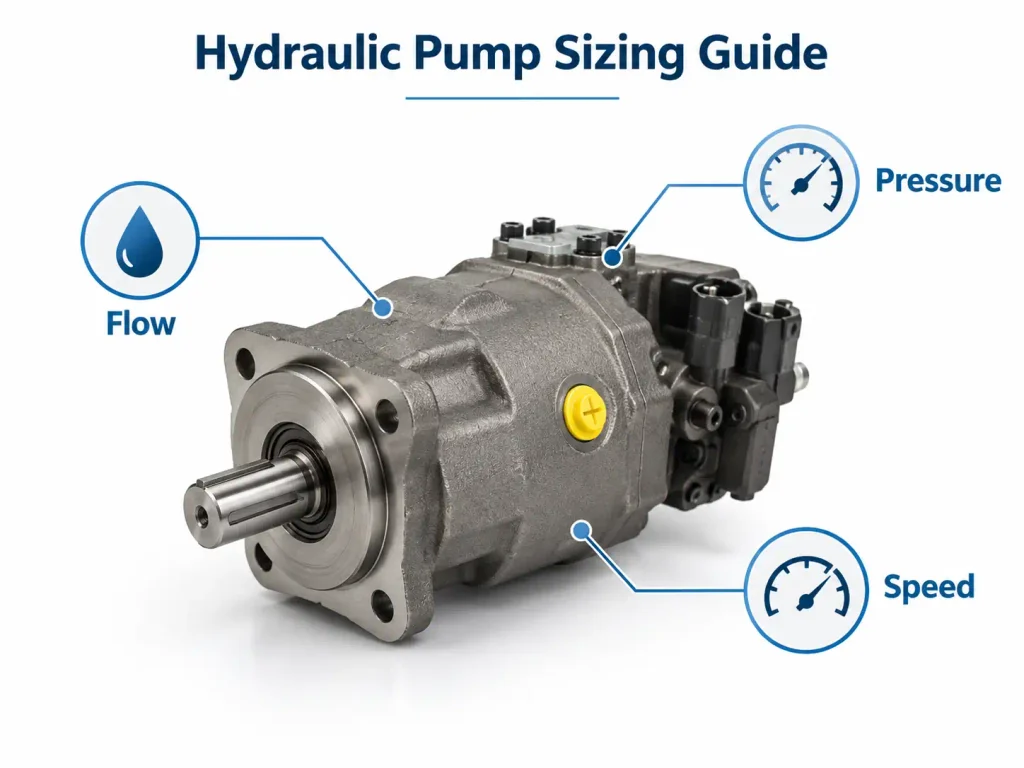
Hydraulic systems are the muscle behind modern industry. From construction excavators lifting multi-ton loads on site to CNC machines shaping precision components on the shop floor, the conversion of mechanical energy into controlled fluid power keeps production lines, mobile fleets, and manufacturing cells moving. At the center of every hydraulic circuit sits a single component that determines flow, pressure stability, energy efficiency, and service life: the hydraulic pump. Choosing the wrong pump type can quietly inflate energy bills, generate excess heat, and shorten maintenance cycles, even when pressure ratings on paper look correct.
The three main types of hydraulic pumps are gear pumps, vane pumps, and piston pumps. Each uses a different positive-displacement mechanism to move fluid, and each performs best within a specific pressure, efficiency, and cost range. Gear pumps dominate low-to-medium pressure mobile applications, vane pumps deliver smooth and quiet flow in medium-pressure circuits, and piston pumps provide the high-pressure, high-efficiency performance required for heavy-duty industrial and mobile equipment.
Below is a detailed breakdown of how each pump type works, where it excels, and how to match the right pump to your system requirements.
How Hydraulic Pumps Work
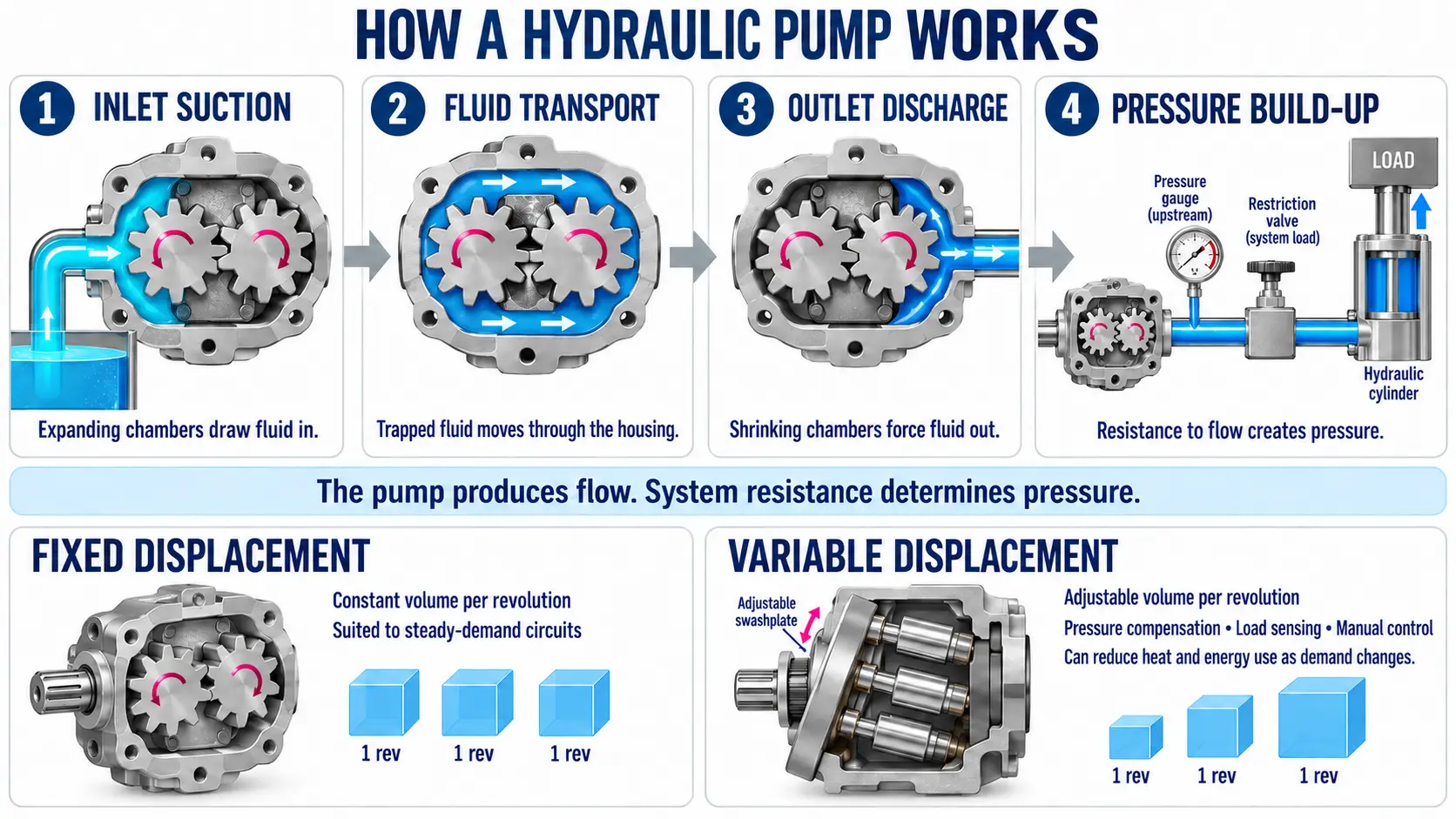
Hydraulic pumps convert mechanical energy from a prime mover into hydraulic energy by generating controlled flow; pressure develops only when that flow meets resistance in the system. This distinction between flow and pressure is fundamental to pump performance and selection.
Hydraulic pumps used in drive systems operate on the positive-displacement principle. During each mechanical cycle, a defined volume of fluid is trapped, carried, and discharged through the pump housing. Because the displacement is fixed by the geometry of the mechanism, output remains stable across varying system pressures, which is what enables hydraulic actuators to produce predictable force and motion.
The operating sequence follows four stages:
- Inlet suction – Expanding chambers at the inlet create a local low-pressure zone, drawing fluid from the reservoir.
- Fluid transport – Internal components such as gears, vanes, or pistons carry the trapped fluid through the housing.
- Outlet discharge – Decreasing chamber volume forces fluid into the hydraulic circuit.
- System pressure build-up – Pressure rises only when fluid encounters resistance from valves, actuators, or the load.
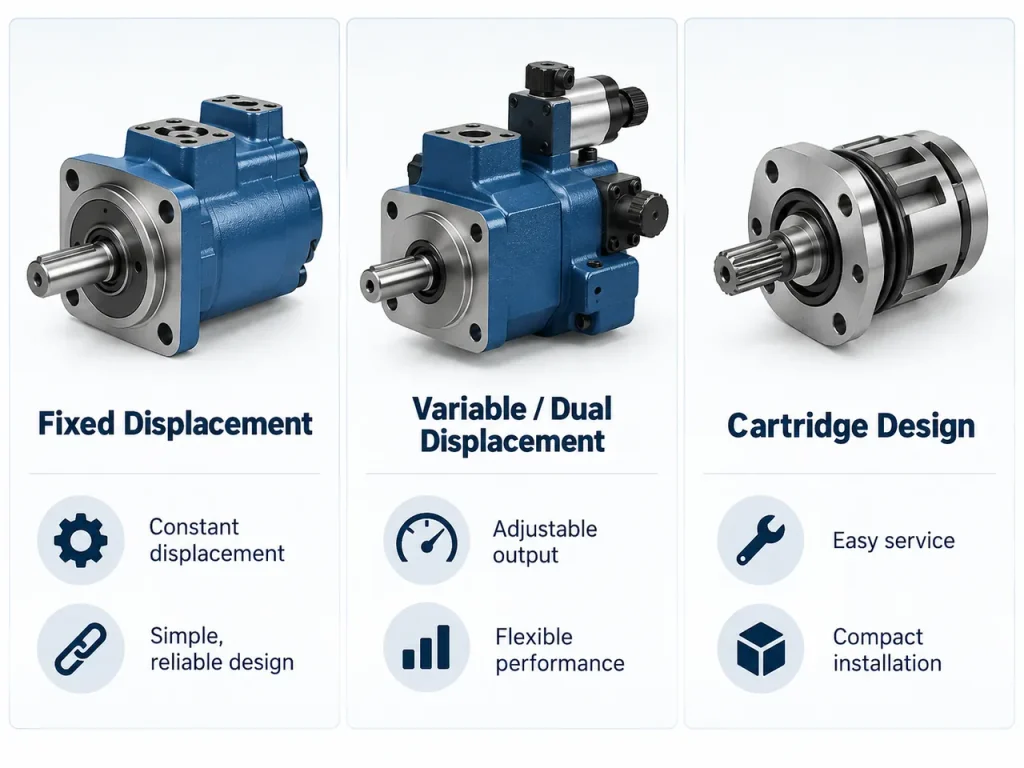
Pumps are further divided by displacement mode. Fixed-displacement pumps deliver a constant volume per revolution, suited to steady-load circuits. Variable-displacement pumps adjust output through pressure compensators, load-sensing regulators, or manual controls, which reduces heat generation and improves energy efficiency in systems with fluctuating demand.
Gear Pumps – Compact, Durable, and Cost-Effective
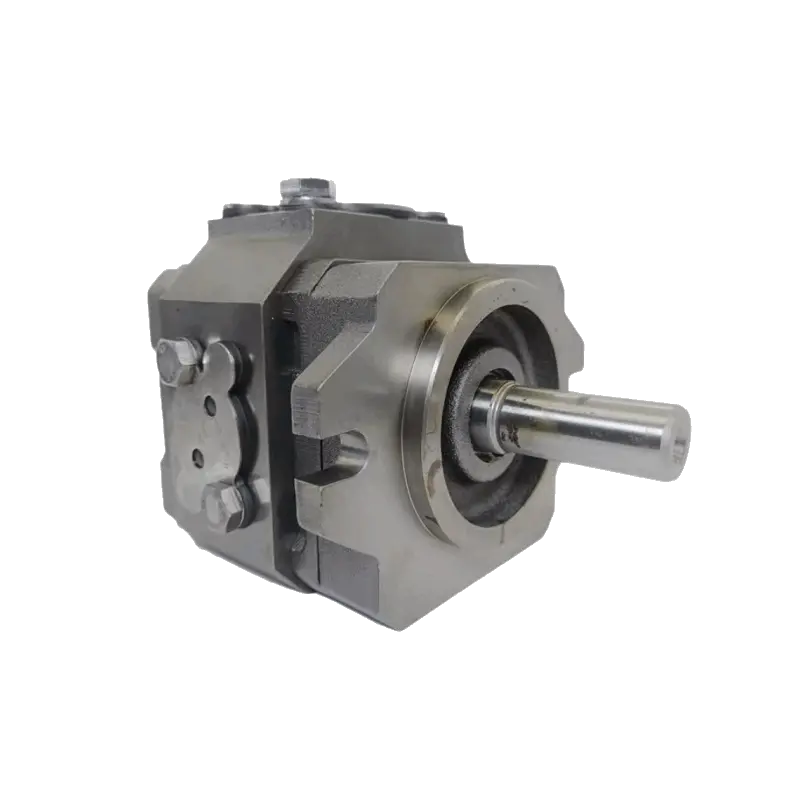
Gear pumps are the most common type of hydraulic pump, accounting for the largest share of the global market thanks to their simple design, low cost, and ability to operate in contaminated environments. They use two meshing gears rotating inside a tight-fitting housing to move fluid from the inlet to the outlet, where the meshing teeth force the oil into the discharge line.
There are two main constructions. External gear pumps use two identical gears that mesh externally and are widely used in fixed-displacement circuits. Internal gear pumps pair a smaller inner gear with a larger outer ring gear separated by a crescent-shaped spacer, producing smoother flow and handling higher-viscosity fluids.
Advantages of Gear Pumps
- Lowest initial cost among the three main types, typically 40–60% below equivalent piston units.
- High contamination tolerance, allowing operation at ISO 19/17/14 cleanliness without rapid wear.
- Simple maintenance with only a few moving parts, reducing downtime and spare-parts inventory.
- Compact footprint ideal for mobile equipment and confined machine layouts.
Limitations and Common Applications
Gear pumps lose 15–20% volumetric efficiency at pressures above 200 bar due to internal leakage between gear teeth and housing clearances. Fixed-displacement designs also limit flexibility in variable-load systems.
Typical applications include agricultural tractors, forklifts, lubrication circuits, hydraulic power units, log splitters, and simple mobile attachments where rugged reliability matters more than precision.
Vane Pumps – Smooth, Quiet, and Balanced Flow
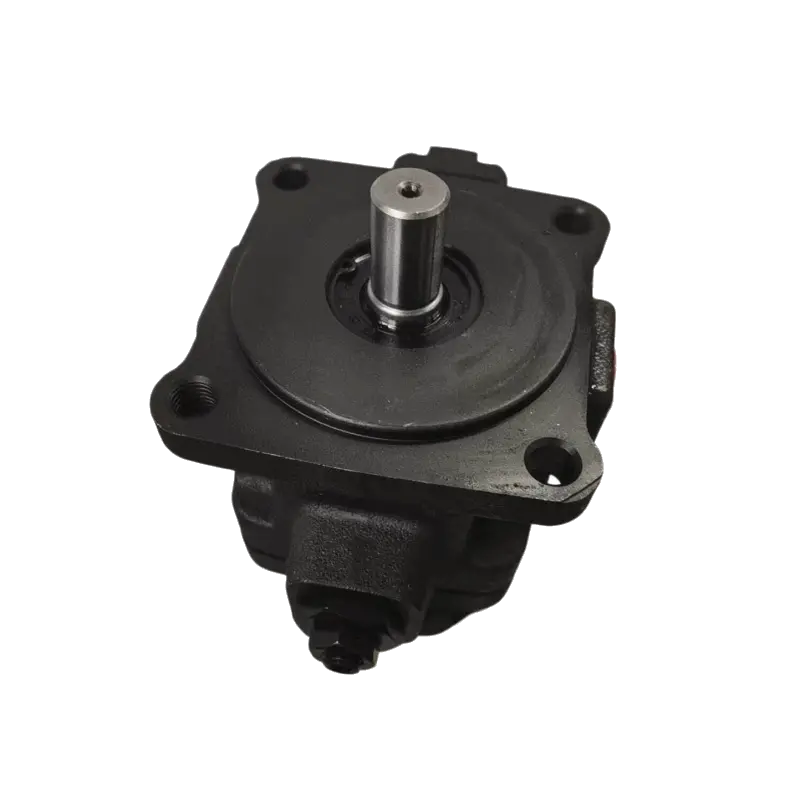
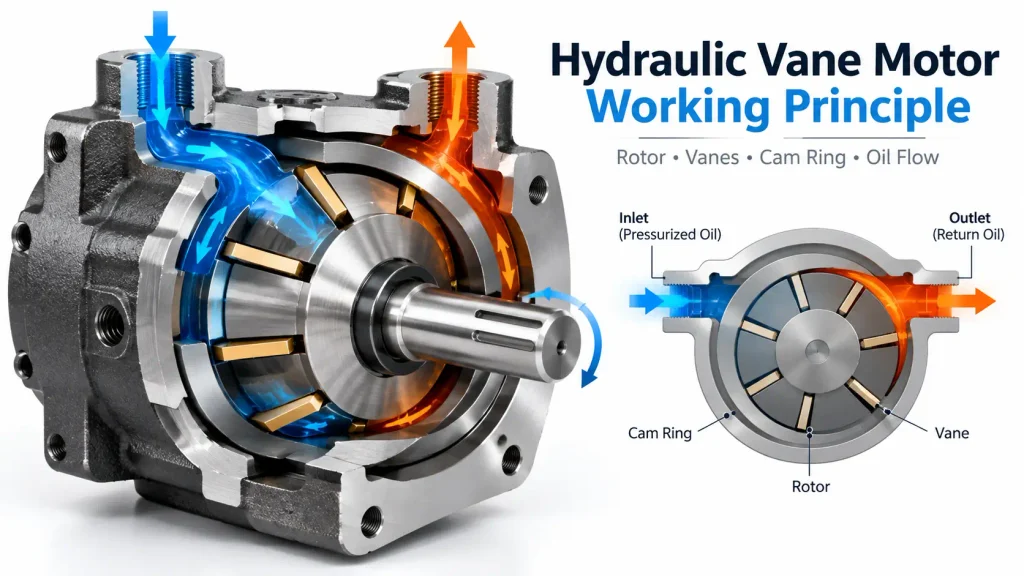
Vane pumps use a rotor fitted with sliding vanes inside an eccentric cam ring to produce uniform, low-pulsation flow at moderate pressures, making them the preferred choice for noise-sensitive and precision applications. As the rotor turns, centrifugal force or hydraulic pressure pushes the vanes outward against the cam ring, creating chambers that expand at the inlet and contract at the outlet.
Vane pumps come in two main configurations. Unbalanced (single-acting) designs are simpler and available in both fixed and variable displacement. Balanced (double-acting) designs use an elliptical cam ring to cancel out radial side loads on the shaft, extending bearing life and allowing higher operating pressures.
Advantages of Vane Pumps
- Quieter operation than gear pumps, typically 65–75 dB versus 75–85 dB.
- Higher volumetric efficiency in the medium-pressure range, generally 85–92%.
- Self-compensating for wear, as vanes extend further as tips erode to maintain seal integrity.
- Smooth, low-pulsation flow suited to machine tools and laboratory equipment.
Limitations and Common Applications
Vane tips and cam rings are sensitive to particulate contamination. Particles above 5 microns can scratch the vane tips or score the stator, dropping efficiency by more than 15% within a few thousand operating hours. Vane pumps are therefore best paired with ISO 18/16/13 or cleaner filtration.
Typical applications include CNC machine tools, injection molding machines, automotive power steering systems, hydraulic elevators, and industrial power units where smooth flow and low noise are priorities.
Piston Pumps – High Pressure and Precision Control
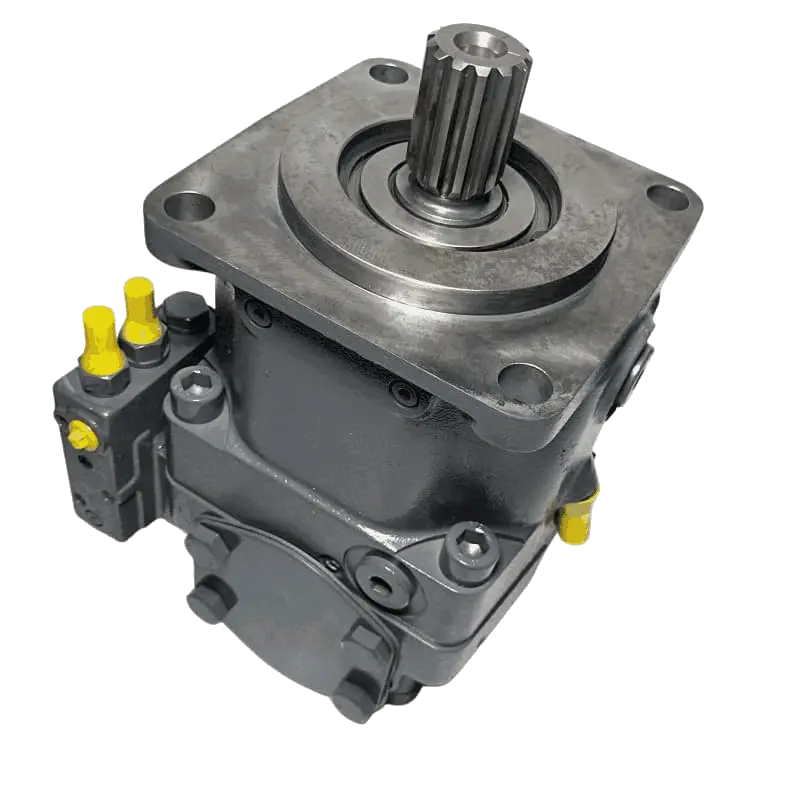
Piston pumps achieve the highest volumetric efficiency and pressure capability of all hydraulic pump types, making them the standard choice for high-power, high-precision systems operating above 300 bar. Pistons arranged in a cylinder block reciprocate as the block rotates, drawing fluid in during the suction stroke and forcing it out during the discharge stroke.
Two principal designs dominate the market. Axial piston pumps position pistons parallel to the drive shaft and use either a swashplate or bent-axis mechanism to convert rotation into reciprocating motion. They dominate mobile closed-loop transmissions and most industrial high-pressure circuits. Radial piston pumps arrange pistons perpendicular to the shaft around an eccentric cam or crankshaft, delivering extremely high pressure and large displacement for heavy industrial applications.
Advantages of Piston Pumps
- Highest volumetric efficiency of any hydraulic pump type, typically 92–98%.
- Continuous pressure ratings from 350 bar up to 700 bar in radial designs.
- Variable-displacement control through swashplate angle adjustment, enabling load-sensing and pressure-compensation strategies.
- Long service life exceeding 10,000 hours when paired with clean hydraulic oil.
Limitations and Common Applications
Piston pumps require the cleanest hydraulic fluid of all three types, typically ISO 16/14/11 or better. They are also the most expensive and structurally complex, demanding precision manufacturing and skilled maintenance.
Typical applications include excavators, mobile cranes, injection molding machines, hydraulic presses, aerospace flight control systems, mining equipment, and large industrial hydraulic power units where high force density and precise control justify the higher investment.
Beyond the Main Three: Other Pump Types
Beyond gear, vane, and piston designs, several secondary pump types serve specialized roles in hydraulic and fluid-transfer systems. Screw pumps, for example, use two or three intermeshing Archimedes screws to deliver high flow at low pressure, typically below 100 bar, and are valued for quiet operation and smooth delivery. They appear in marine power units, lubrication systems, and low-pressure industrial circuits. Gerotor and lobe pumps represent internal-gear variations that combine smooth flow with contamination tolerance, often used as charge pumps or steering units. While these designs cover important niches, gear, vane, and piston pumps together account for the overwhelming majority of hydraulic pump applications in mobile and industrial equipment.
Gear vs Vane vs Piston – Side-by-Side Comparison
No single pump type is best across all hydraulic applications; the right choice depends on pressure, flow profile, contamination tolerance, noise limits, and total lifecycle cost. The table below summarizes the key performance dimensions engineers and buyers typically compare.
| Performance Factor | Gear Pumps | Vane Pumps | Piston Pumps |
| Working principle | Meshing gears transfer fluid | Sliding vanes in cam ring | Reciprocating pistons in cylinder block |
| Typical pressure range | Up to 210 bar (some up to 250 bar) | 70–210 bar | 280–700 bar |
| Volumetric efficiency | 80–92% | 85–92% | 92–98% |
| Flow smoothness | Noticeable pulsation | Smooth, stable | Very smooth |
| Noise level | 75–85 dB | 65–75 dB | 70–80 dB |
| Contamination tolerance | High (ISO 19/17/14) | Medium (ISO 18/16/13) | Low (ISO 16/14/11) |
| Displacement options | Mostly fixed | Fixed and variable | Fixed and variable |
| Relative cost | Low | Medium | High |
| Typical life | 4,000–8,000 h | 5,000–9,000 h | 10,000–20,000 h |
| Best-fit applications | Mobile equipment, lubrication, power units | Machine tools, injection molding, power steering | Heavy construction, presses, aerospace, mining |
Gear pumps win on cost and contamination tolerance. Vane pumps win on noise and flow uniformity. Piston pumps win on efficiency and pressure capability. Lifecycle analysis often shows that a higher-efficiency piston pump recovers its price premium through lower energy consumption and longer service intervals in heavy-duty operation.
How to Choose the Right Hydraulic Pump
Selecting the correct pump type is a lifecycle calculation that balances pressure requirements, flow profile, fluid cleanliness, duty cycle, and total cost of ownership. Five variables consistently determine the right match in practice.
- System pressure requirements – Low-to-medium pressure circuits are well served by gear pumps; medium pressure with smooth flow points to vane pumps; high-pressure or heavy-duty systems require piston pumps.
- Flow demand and load behavior – Constant flow under steady load favors fixed-displacement gear pumps; variable or dynamic flow benefits from variable-displacement vane or piston units.
- Fluid cleanliness and operating environment – Harsh or contaminated environments favor gear pumps; controlled factory conditions suit vane and piston pumps. Fluid cleanliness targets follow ISO 4406 solid contamination codes, which classify oil purity by particle count per milliliter.
- Duty cycle and efficiency targets – Continuous-duty industrial systems benefit most from high-efficiency piston pumps despite higher upfront cost.
- Noise, space, and installation constraints – Indoor or noise-sensitive environments point to vane pumps; compact mobile layouts favor gear pumps; high-performance stationary systems rely on piston pumps.
A practical example illustrates the trade-off. Consider a 18 kW hydraulic press running a single shift. An external gear pump rated at 88% initial efficiency may drop to 75% volumetric efficiency after three years of abrasive wear, wasting roughly 900 W continuously, or about 2,200 kWh per year. An axial piston pump at higher initial cost but 95% efficiency consumes less energy, generates less heat, and lasts more than twice as long. Over a five-year horizon, the energy savings alone can exceed the piston pump’s price premium.
Matching pump type to system conditions matters more than chasing the highest specification. A well-matched gear pump running at its design pressure will outperform an oversized piston pump struggling with inadequate filtration.
FAQ
What are the four types of pumps?
The “four types” classification depends on which standard is applied. In fluid power, hydraulic pumps are most commonly grouped as positive-displacement and non-positive-displacement designs. Within positive-displacement hydraulic pumps, the four most cited types are gear, vane, piston, and screw pumps. In a broader pumping context, the four major categories often referenced are centrifugal, positive-displacement, axial-flow, and rotary pumps, which include hydraulic as well as general fluid-transfer applications.
Which type of hydraulic pump has the highest efficiency?
Piston pumps deliver the highest volumetric and overall efficiency, typically reaching 92–98% volumetric efficiency and 85–95% total efficiency at rated conditions. Their precision-machined components and tight internal tolerances minimize internal leakage, which is the primary source of efficiency loss in hydraulic pumps.
Are gear pumps still used in modern hydraulic systems?
Yes. Gear pumps remain the most widely installed hydraulic pump type globally, particularly in agricultural machinery, forklifts, mobile hydraulic power units, and lubrication systems. Their low cost, simple construction, and tolerance to contaminated fluid keep them relevant in cost-sensitive and field-service applications where high efficiency is less critical than reliability and ease of maintenance.